Discourse Analyses of the Books of Micah and Revelation by Stephen Schooling
Dr Stephen Schooling has kindly provided me with copies of an English translation of his 1998 European Journal of Theology article (originally published in French) on the Prophet Micah’s Role and Message and his 2004 Ph.D. thesis on the book of Revelation. This thesis is in two files as it facilitates reading on a computer with both parts open at the same time.
Stephen Schooling, “The Structure of the Book of Revelation: A Discourse Analysis Perspective, A dissertation submitted in accordance with the requirements for the degree of Doctor of Philosophy of Trinity College, Bristol validated by the University of Bristol,” (University of Bristol, 2004).
- Click here to download Part 1
- Click here to download Part 2
- Click here to download both parts in a single .zip file
Abstract
The present work is a discourse analysis of the book of Revelation. The analysis, using linguistic tools, reveals that the book is composed of seven cycles arranged in a parallel, chiastic structure. Each cycle is organized according to a different, seven-fold motif which usually manifests itself in seven distinct sub-units. The seven cycles are bracketed and connected together by a narrative framework. Cycles 1 and 7, being the introduction and the conclusion, are in parallel to each other, while Cycles 2-6 form a separate unit of text with its own introduction and conclusion. The whole book, and especially Cycles 2-6, are intricately connected by a series of overlap links. The primary contrastive themes are those of judgment and salvation. Both themes are present together in Cycles 1 and 7, while in Cycles 2-6 the judgment theme is developed by the seven-fold motif of the cycles, while the salvation theme is developed separately in a series of interludes. At the informational level, Cycle 7 and Cycle 4 are the most important parts of the book being respectively, the most naturally prominent and the most specially prominent cycles. The overall purpose of the book is hortatory in nature, with the volitional schema being carried primarily by Cycle 1 and the narrative framework. This means that Cycle 1 and the narrative framework are the most important parts of the book in terms of the overt development of its hortatory purpose. A summary of the analysis may be found in Chart 1 on page 236.Stephen Schooling, “Micah’s Surprising Role and Message. A Discourse Analysis Study of the 12 Minor Prophets”. Being a translation from the French with additions and improvements of an article “La Place de Michée Dans le Contexte des Douze Petits Prophètes,” originally published in the European Journal of Theology 7.1 (1998): 25-36.
This dissertation has been revised and expanded and will reappear in book form entitled
The Timeless Texture of the Book of Revelation; A Holistic Discourse Analysis
and will be forthcoming in the course of 2025.
Stephen Schooling, “Micah’s Surprising Role and Message. A Discourse Analysis Study of the 12 Minor Prophets”. Being a translation from the French with additions and improvements of an article “La Place de Michée Dans le Contexte des Douze Petits Prophètes,” originally published in the European Journal of Theology 7.1 (1998): 25-36. [Click here to download this article]
Looking for more material on discourse analysis? Go here.
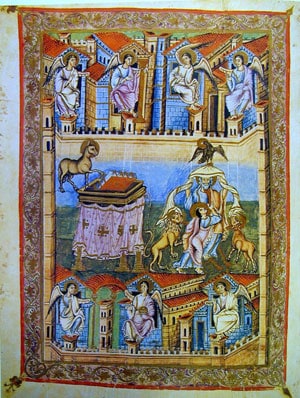
Main image: Frontispiece, Book of Revelation, Bible of San Paolo fuori le Mura, 9th century. Source: Wikipedia