






Theology on the Web helps over 2.5 million people every year to find high quality theological resources that will help to equip them to serve God and to know Him better (2 Timothy 2:15). Like other websites that provide free services, it is dependent on donations to enable it to grow and develop and only 0.004% of visitors currently do so. If you would like to support this site, please use one of the options to the right of this message.
A.R. Millard & D.J. Wiseman, eds., Essays on the
Patriarchal Narratives. Leicester: IVP, 1980. Hbk. ISBN: 0851117430.
pp.157-188.
[Reproduced by permission]
To read the other essays, click here.
[p.157]
1. INTRODUCTION
For well over a hundred years the religious ideas and practices of the patriarchs have attracted scholarly attention. In view of the place Abraham occupies in various religious traditions this is understandable. What is more surprising is that in the scholarly debate, no clear consensus about the content of his religion has emerged.[2]
At least four factors can be pinpointed which have contributed to this uncertainty. First, Genesis itself says relatively little about patriarchal religion. It tells us much about their religious experiences, but little about their beliefs or religious practices.
Secondly, the accounts of the patriarchs as we now have them are all post-Sinaitic, that is they presuppose the innovations in belief and practice that date from the time of Moses. Various texts allude to the differences between the religion of Moses and that of the patriarchs. For example Exodus 6:3 says: 'I appeared to Abraham, to Isaac, and to Jacob, as El Shaddai (God Almighty, RSV), but by my name the LORD I did not make myself known to them.' Joshua 24:14 states: 'Put away the gods your fathers served beyond the River, and in Egypt, and serve the LORD.' Both these texts appear to contrast the religious ideas and practices of the fathers with the post-Mosaic period. Yet Genesis itself gives very few hints that the patriarchs worshipped other gods. Indeed it usually describes the God who appears and speaks to the patriarchs as 'the LORD' (Yahweh), i.e. the God of Moses.
This prompts the question (thirdly): is this identification of the patriarchs' God with that of Moses a theological assertion by the writer of Genesis, who was
[p.158]
sure the same God had spoken to Abraham as spoke to Moses? Or do the statements in Genesis implying that Yahweh revealed himself to the patriarchs correspond to the patriarchs' own conception of the God they worshipped? Answers to this most basic question are complicated by further considerations. It is generally held that Genesis is composed of several sources giving rather different accounts of the religion of the patriarchs.
And last but not least, the theological convictions of those who study Genesis affect their conclusions. Jews and Christians who regard Abraham as the father of the faithful are reluctant to accept that he was a polytheist who served strange gods. On the other hand, scholars who hold that religion is essentially a human creation are hardly likely to suppose that the patriarchs were pure monotheists.
These briefly are the main problems that confront a would-be historian of Old Testament religion in describing the beliefs and religious practices of the patriarchs. To arrive at the pure historical truth one needs to be able to shed one's own presuppositions, and distinguish between the interpretations of Genesis and the underlying facts. Such a programme is regrettably impossible. My aims are more modest. In this essay I shall first of all set out the statements of Genesis about patriarchal religion. These raw statements will enable us to grasp how the final editor of Genesis viewed patriarchal religion.
Since it is generally held that Genesis is made up of earlier sources J, E and P, the pictures of patriarchal religion found in them will be described next. Assumptions about the dates of these sources have played a large part in assessing the validity of these different pictures. But in an effort to distinguish the authentic early elements in the accounts from later interpretations more recent scholarship has emphasized the similarities between other early Semitic religions and the beliefs of the patriarchs. So a few of the most representative accounts of patriarchal religion will be surveyed next.
Finally an attempt will be made to evaluate the different suggestions. If one is not to fall back on dogmatic assumptions, there is only one way to do this: to ask which of the supposed reconstructions is most self-consistent and at the same time most true to the biblical data. In particular I shall focus on three questions. Did the patriarchs worship a God called Yahweh? Are the divine promises made to the patriarchs an early element in the tradition or were they added by later editors? Did patriarchal religion differ from later Israelite religion, or are the accounts in Genesis simply
[p.159]
retrojections of later first-millennium beliefs and practices into the distant past?
2. THE RAW DATA
2.1. The Names of God
According to Genesis God revealed himself to the patriarchs under various different names, and the patriarchs used a variety of divine epithets in their prayers. Abraham knew of Yahweh, Elohim, El Elyon, El Shaddai, El Roi, and El Olam. Isaac knew of Yahweh, Elohim and El Shaddai. Jacob knew of Yahweh, Elohim, El Bethel, Pahad Yishaq (Fear or relative of Isaac) and El Shaddai. However, since the use of some of these epithets may be ascribed to editorial identification of different deities, it is necessary to distinguish carefully between the various usages of the divine names, i.e. whether they occur in the framework of the story and therefore represent the editor's understanding of the situation or whether they form part of the dialogue in the story and therefore may represent the wording of the source, rather than an editor's understanding of his source. Sometimes more than one divine name is used in the same passage, and in such cases it is more possible that one of the items is an editorial addition identifying the two divine names. Such problematic cases will therefore be ignored in the following analysis. The results may be conveniently summarized in tabular form.[3]
Table 1
Distribution of Divine Names by Narrative Context
Abraham |
Jacob |
Joseph |
|||||||
Framework |
Dialogue |
Framework |
Dialogue |
Framework |
Dialogue |
||||
| Yahweh | 45 | 20 | (2) | 11 | 14 | (0) | 11 | 0 | (0) |
| Elohim | 24 | 11 | (2) | 14 | 28 | (1) | 2 | 30 | (0) |
| El Shaddai | 0 | 1 | (1) | 0 | 2 | (1) | 0 | 2 | (0) |
| El (other names) | 1 | 3 | (0) | 1 | 3 | (2) | 0 | 0 | (0) |
| Adonai | 0 | 6 | (0) | 0 | 0 | (0) | 0 | 0 | (0) |
| Mixed | 1 | 9 | (0) | 0 | 6 | (1) | 0 | 2 | (1) |
Full discussion of the data in this table will follow later, but three points are immediately clear. First, in all three cycles El Shaddai only occurs in the dialogue, never in the narrative framework of the stories.
[p.160]
This suggests that at least this term is an early element in the tradition.
Secondly, in the Joseph cycle Yahweh is used only in the narrative framework, never in the speeches within the story. There, El Shaddai or Elohim is consistently used. This might be thought to be due to the setting of the stories, where the sons of Jacob are constantly dealing with Egyptians and other foreigners. But in fact in many of the situations where God is mentioned, the brothers are talking to each other or with their father Jacob (e.g. 42:28; 45:5, 7, 8, 9; 50:25). This could suggest that the narrator identified the God of the patriarchs with Yahweh but that his sources did not refer to Yahweh, but only to Elohim or El Shaddai and that he faithfully preserved this feature in his dialogues. Whether this hypothesis can be sustained will be discussed further below.
Thirdly, and this apparently contradicts the second point, in the Abraham cycles Yahweh and Elohim are found both in the narrative framework and in the dialogue. In these stories then, both Yahweh and Elohim have equal claims to originality. If only one of the terms originally belonged to the traditions, later editors have not only reworded the narrative framework but also the dialogue. Another way of resolving this confusion is usually preferred, however, namely the postulation of different sources. It will be argued below that this solution is also fraught with difficulty.
Discussions of patriarchal religion tend to concentrate on the names of God to the virtual exclusion of other aspects of their belief and practice, simply because the source material is so much more scanty in this respect. However, for a rounded picture it is necessary to mention the few details found in Genesis.[4] Altars are built, sacrifices, libations, and covenants are made; prayer, circumcision, tithes, vows, and ritual purification are other ingredients of their religion. Household gods were also highly valued. Apart from the last point the practice of the patriarchs apparently differed little from their successors. However, the texts are quite vague about the how and where of sacrifice. In general they worship in places that were well-known in later times for their sanctuaries. Yet the impression is conveyed that the patriarchs offered sacrifice outside the towns, presumably without the aid of the local priesthood. This would be somewhat irregular by later standards. It would of course have been even more surprising had the patriarchs regularly worshipped at Canaanite shrines staffed by Canaanite priests; though Genesis 14 does suggest that on one occasion at least this is what Abraham did.
[p.161]
If Genesis says little about the patriarchal mode of worship, it says much more about the divine promises made to them, and that for two reasons. First, their faith in these promises and their obedience to God's word served as a model to later generations of faithful Israelites. And secondly, the promises provided a justification for the settlement of the land. Three main themes recur, sometimes together and other times separately: they are the promise of numerous descendants who will form a great nation, the promise of the land and the promise of blessing on Abraham's descendants and through them to the whole world. These promises are spelt out very fully in many passages, and beside them the references to actual religious practices are relatively brief and fleeting.
How far is the picture of patriarchal religion modified by the classical source-critical analysis, which distributes the material among J, E, and P? A table will again be used to present the results.[5]
Table 2
Distribution of Divine Names by Sources
Abraham |
Jacob |
Joseph |
||||
Framework |
Dialogue |
Framework |
Dialogue |
Framework |
Dialogue |
|
| P Source | ||||||
| Yahweh | 2 | - | - | - | - | - |
| Elohim | 12 | 3 | 5 | 1 | - | - |
| El Shaddai | - | 1 | - | 2 | - | 1 |
| JE Redaction | ||||||
| Yahweh | 1 | - | - | - | - | - |
| E Source | ||||||
| Yahweh | 1 | 2 | - | - | - | - |
| Elohim | 12 | 8 | 9 | 19 | 1 | 27 |
| El (Bethel) | - | - | - | 3 | - | - |
| El Shaddai | - | - | - | - | - | 1 |
| Adonai | - | 1 | - | - | - | - |
| Mixed | - | - | - | 3 | - | 1 |
| J Source | ||||||
| Yahweh | 41 | 18 | 11 | 14 | 11 | - |
| Elohim | - | - | - | 8 | 1 | 3 |
| El Roi | - | 1 | - | - | - | - |
| Adonai | - | 5 | - | - | - | - |
| Mixed | 1 | 8 | - | 3 | - | 1 |
This table evaluating the use of the divine names on the basis of the source analysis gives a more nuanced picture than the simple analysis offered earlier, but the same three facts are clear. First, El Shaddai is found
[p.162]
only in the dialogue, never in the framework. Secondly, in the Joseph cycle, Yahweh is used only in the framework of the story, never in the dialogues. There Elohim or El Shaddai is used. Thirdly, in the J, E and P versions of the Abraham cycle, Yahweh is used in the framework, and in the dialogue as well in J and E. Similarly, in the E and P versions of the Abraham and Jacob cycles, Elohim is found in both the framework and in the dialogues.
The source analysis by itself therefore does not give a clear answer to the question of the names under which the patriarchs worshipped God. The conclusions that can be drawn from these statistics depends on the assumptions made about the relationships between the sources. If the sources were completely independent and from the same period, their evidence should be given equal weight. On this basis it would be right to conclude that Elohim was certainly the earliest word for God. However, it is generally supposed that J is some hundred years older than E and nearly 500 years older than P, and that the later sources know the content of the earlier sources. On this assumption only J can be really relied on. This would suggest that Yahweh was the earliest name of God, and was later displaced by Elohim and El Shaddai. This is in flat contradiction to the usual understanding of Exodus 6:3 (generally assigned to P), which states that the patriarchs knew God as El Shaddai, not as Yahweh,which was a new name revealed to Moses. Though it has been argued that Exodus 6:3 does not really mean this, and that the usual tradition misconstrues it, advocates of the usual translation point out that the P passages in Genesis nearly always use Elohim or El Shaddai (Yahweh only occurs twice in P Genesis), which suggests that P indeed meant that the patriarchs did not know Yahweh as the name of deity. Yet this explanation side-steps a major problem: how could the author of P affirm that the patriarchs did riot know the name of Yahweh when both the earlier sources J and E affirm that they did? If one supposed that the author of P was ignorant of all the material in J and E, which constitute five sixths of the patriarchal narratives,[6] this position would be defensible. But it seems improbable, and some writers have gone further, affirming that P not only knew JE, but that these were the main sources of P.[7] It is evident that it is impossible to discover the content of patriarchal religion without making a number of judgments on the date and interrelationship of the pentateuchal sources.
2.2. Religious institutions
[p.163]
If the analysis of divine names is inconclusive, do the religious institutions mentioned in the different sources give any better clue to their relative dates and possible interdependence? Table 3 sets out the distribution of the references in the various sources.
Table 3
Religious Institutions in Genesis
J |
l/3J |
E |
½E |
P |
|
| Divine Promises : descendants | 6 | 2 | 2 | 1 | 3 |
 : land : land |
6 | 2 | - | - | 3 |
| : blessing |
5 | 1.7 | 2 | 1 | 2 |
| Covenant : divine | 1 | .3 | - | - | 1 |
| : human |
1 | .3 | 2 | 1 | - |
| Altar building | 4 | 1.3 | 3 | 1.5 | - |
| Sacrifice | - | - | 3 | 1.5 | - |
| Pillar erection | 2 | .7 | 2 | 1 | - |
| Libation | 1 | .3 | 1 | .5 | - |
| Tithe | - | - | 1 | .5 | - |
| Vows | - | - | 1 | .5 | - |
| Ritual purification | - | - | 1 | .5 | - |
| Circumcision | - | - | 1 | .5 | 3 |
| Household gods | - | - | 2 | 1 | - |
| Calling on the LORD | 4 | 1.3 | - | - | - |
| Intercessory prayer | 4 | 1.3 | 3 | 1.5 | - |
In analysing this table two things must be borne in mind. First, the figures are not as precise as in the tables dealing with the divine names, because enumerating the number of references to such things as promises is somewhat subjective. What I have tried to do is to list the number of occasions an institution is referred to rather than the number of times a particular word appears. Thus because only one altar is meant in Genesis 35:1, 3, 7, it counts only once in the table though it is mentioned three times. Similarly the numerous references to circumcision in Genesis 17 count as one. Second, it must be remembered that E is twice as long as P, and J is three times as long. Thus to make the figures of J and E comparable with P, those of E must be halved and those of J divided by three. These results are found in the second and fourth columns.
When this is done, it becomes difficult to see any clear trend between the sources. E contains references to a wider span of institutions than any other source, and P to the narrowest range. P's failure to mention altar
[p.164]
building and sacrifice might be thought to represent his reluctance to portray the patriarchs offering sacrifice without priestly intervention.[8] But this is unlikely, for P (Genesis) also omits reference to other institutions which did not require priests, e.g. tithing, vowing, ritual purification and prayer. Furthermore the regulations in Leviticus 1, 3 (also P) clearly envisage the layman slaying sacrificial animals. The priests simply have to sprinkle the blood and place the carcase on the altar. In view of the brevity of the references in Genesis to sacrifice, it seems unlikely that the potential usurpation of priestly prerogative by the patriarchs can be the reason for the omission of sacrifice from P. More likely it is statistical variation. The brevity of P makes it intrinsically less likely that it would give such a comprehensive coverage of the religious institutions as J or E.
Analysis of the distribution of religious institutions is thus of little use in determining the relationship between the sources or their relative age. Since everything mentioned in P is also found in J or E, P could be either earlier or later than the other sources. If, as is customary, it is assumed that J and E are earlier than P, it follows that no religious institution mentioned in the patriarchal narratives is later than the composition of these sources, for nothing is found in P which is not already found in J or E. These religious institutions could therefore date from patriarchal times.
This preliminary discussion of the question of the divine names and religious institutions has proved inconclusive, because the analysis of the material depends too much on a priori assumptions about the existence, extent, date and interrelationship of the sources. For this reason modern discussions of patriarchal religion have skirted round the source-critical problem and attempted to make comparisons between other near-eastern religions and the data of Genesis to arrive at a picture of patriarchal religion. But here again assumptions have to be made. With which type of religion should Genesis be compared? The point of comparison chosen and the individual scholar's evaluation of the reliability of the patriarchal tradition have largely determined his final picture of patriarchal religion.
3. THREE VIEWS OF PATRIARCHAL RELIGION
3.1. A. Alt and 'The God of the Fathers'
The extraordinary influence of Alt' s essay 'The God of the Fathers'[9] is proved by its longevity. Though first pub-
[p.165]
lished over fifty years ago, it was not translated into English until 1966 and it still is the point of departure for modern discussions of patriarchal religion. For this reason, our survey of critical theories about patriarchal religion begins with Alt.
Alt begins his essay by surveying the problem of recovering the content of patriarchal religion. The compiler of Genesis identified Yahweh with the God of Abraham, and the God of Isaac with the God of Abraham and so on. For him these were different names of the same God. But according to Alt the historical development of the religion was more complex, and often the compiler of Genesis has read his own ideas into the traditional material, thus distorting the picture of the patriarchal age.
In reality in the earliest phase of their religion the patriarchs worshipped the gods of the fathers. The oldest names for the patriarchal deities in Genesis are 'Fear of Isaac' and 'Mighty One of Jacob', alternatively described as 'the god of Isaac' or 'the god of Jacob'. A third deity is also mentioned, viz. 'the god of Abraham'. According to Alt these were three different gods worshipped by different tribes or groups of tribes in their nomadic period, ie. the patriarchal age prior to the settlement of Israel in Canaan. He tries to demonstrate the antiquity of these names by comparing them with Nabataean and Palmyrene inscriptions in Greek and Aramaic dating from the first century BC to the fourth century AD. These tribal peoples were also nomadic and they worshipped 'the god of X', where X was the name of the founder of the cult. Different tribes worshipped different deities. When a god revealed himself to a person, that person established a cult for him, and the god in question guaranteed the protection of the worshipper's group or tribe.
Now according to Alt different tribal groups arrived in Canaan at different times bringing with them different deities. The largest group, the Jacob tribes, worshipped the god of Jacob and settled in the East and North of the country. Another group, the Isaac tribes, settled round Beersheba and worshipped the god of Isaac, while the Abraham group settled round Mamre and worshipped the god of Abraham. In course of time the El gods of the local Canaanite shrines were identified with the gods of the fathers, thus giving these tribal gods their own name. Instead of an anonymous god of Jacob, names like 'El, the God of Israel' (33:20) were invented. Furthermore, interactions between the tribes led to a pooling of their history. To prove that the tribes were related to each other, genealogies of the tribal founders were construc-
[p.166]
ted. Abraham became the grandfather, and Isaac the father of Jacob. Simultaneously the gods whom the different patriarchs served were identified with each other, so that Genesis can talk about the God of Abraham and the God of Isaac meaning the same deity. The final stage in the development of pre-monarchic religion was the introduction of Yahweh as the national God of all Israel in the Mosaic period. Exodus 3 and 6 make it clear that the God of the Fathers was first called Yahweh by Moses. The worship of Yahweh by the nation did not exclude the worship of the tribal gods, such as the God of Abraham, at the tribal sanctuaries, but in course of time Yahweh was identified with these local deities as well.
Now all the pentateuchal sources were written some time after this religious evolution was complete, and they reflect their different authors' understanding of the situation and many of the texts must be regarded as anachronistic. They reflect the later writers' concept of the patriarchal religion, rather than describing the true historical situation. Thus the references to 'the God of Abraham' in Genesis 26:24 and 'the God of Abraham and the God of Isaac' in 32:10 are just the invention of J.[10] Alt does not give a complete list of the passages he regards as authentic reflections of the patriarchal religion, but the following five would seem to be the few that pass his critical sieve: 31:5, 29, 53; 46:3; 49:25. They are all found in the Jacob material. Though this may seem a narrow base on which to build a theory of patriarchal religion, Alt argued that it was a firm one, because the patriarchal religion he described was so similar to that of the Nabataeans, who centuries later gave up a nomadic way of life to settle on the eastern and southern borders of Canaan.
3.1.1. Evaluation of Alt
The dominating influence of Alt's theory of patriarchal religion can be seen in the standard histories of Old Testament religion. In view of the relatively few texts on which his theory rests, its widespread acceptance is perhaps surprising. If with the hindsight of more recent scholarship, his ideas seem to have certain weaknesses, to his contemporaries they had obvious merits. First, they showed that a thoroughly critical methodology could still discover authentic traces of the patriarchal period in the Genesis narratives. They were not simply the retrojections of later writers' imagination into earlier times. Secondly, though only a few verses actually go back to ancient times, the picture of the gods of the fathers in the authentic verses is remarkably like the God of Genesis. The essence of the tradi-
[p.167]
tion in its most ancient and its most developed form is the same: God revealed himself to the patriarchs; he promised them descendants; he protected them in their wanderings; and, enjoying a special relationship to him, they worshipped him and established holy places in his honour. Only in one respect was there a substantial difference between the patriarchs' religious experience and Genesis' interpretation of it. Each patriarch worshipped the particular deity who had revealed himself to him, but contrary to the assumptions of Genesis and its earlier sources, these deities were different, not one and the same God Yahweh. Though the Genesis editors try to show that Abraham, Isaac, and Jacob all worshipped the same God, and were therefore implicitly monotheistic, critical analysis of the tradition showed that the patriarchs worshipped different deities and the earliest form of religion was essentially polytheistic.
Later discussions of Alt's work have drawn attention to two main weaknesses in his synthesis. First, Lewy[11] questioned his view that the patriarchal gods were really anonymous, known only by their worshippers' names, not their own names. He pointed out that old Assyrian texts from nineteenth-century Cappadocia also spoke of 'god of your/our father' as a description of the high god of Assyria. He argued that the real name of the patriarchal god was El Shaddai, and that 'God of my father Abraham' and similar phrases defined the worshippers' relationship to the deity and were not a substitute for his name. Subsequent studies have shown that phrases like 'God of my father' are well known in the Near East to describe named deities.[12] The second weakness of Alt's approach is the remoteness of his comparative material. The Nabataean inscriptions that he cites are nearly 2,000 years younger than the patriarchal period. In the same year that Alt's article was published, the first discoveries were made at Ras Shamra, ancient Ugarit. These have revolutionized scholarly understanding of second-millennium Canaanite religion, and there have been various studies arguing that the Genesis narratives make better sense understood against this background rather than later Nabataean religion.[13]
3.2. F.M. Cross and 'Yahweh and the God of the Patriarchs'
Of all the recent attempts to understand the religion of the patriarchs against the background of second-millennium near-eastern religion, F. M. Cross's essay 'Yahweh and the God of the Patriarchs' is the most thorough. It was first published in 1962[14] and was republished in an expanded form in 1973.[15]
[p.168]
Cross begins by summarizing Alt's essay we have just discussed. Though he agrees with Alt's general picture of patriarchal religion as a personal clan religion based on revelation to the patriarchs, he disagrees with Alt in seeing the patriarchs' god as originally anonymous. Cross maintains that the patriarchs worshipped the high god of Canaan, namely El. In other words the passages which call the God of the patriarchs, El Shaddal, El Elyon, El Olam, etc., are not secondary later elements that were added to the tradition after the settlement in Canaan, as Alt held, but represent the original name of the God worshipped by the patriarchs. Phrases like 'the God of Abraham' are not used in Genesis because the God Abraham worshipped was anonymous, but to bring out the special relationship that existed between Abraham and his God, El Shaddai.
Cross, like Lewy, argues that since named Assyrian gods could be called 'god of your father', similar phrases in the patriarchal narrative could be taken the same way.[16] Furthermore there is evidence of similar usage in other regions and periods, particularly among early second-millennium Amorites.[17] He further questions whether Alt was correct in supposing that the Nabataean deity Du-Sara was originally anonymous. Since the name was unknown in Transjordan prior to Nabataean settlement, it is likely that the Nabataeans brought the name with them. But whether or not Alt's reconstruction of primitive Nabataean religion is correct, the analogy with the patriarchal period is remote and inappropriate. In Genesis the patriarchs are associated with both Mesopotamia and Egypt, unlike the desert origin of the Nabataeans, and must be presumed to have known the names of numerous deities.[18]
Though names like El Elyon and El Olam are found in Genesis, does
it follow that these names refer to El, the high god of the Canaanites? Cross
admits that names like El Olam could either be understood as 'El, the eternal
one', or as 'the god Olam'. To show that the first possibility is the correct
one, he says it must be shown that Olam, Elyon, and Shaddai are appropriate
epithets of El, as his character is depicted in extrabiblical texts. However,
two titles at least are unambiguous in their reference to El. These are  (Gn. 33:20) which must be translated 'El, the God of Israel' and
'el,[19]
(Gn. 33:20) which must be translated 'El, the God of Israel' and
'el,[19]  (Gn. 46:3) which must mean 'El, the God of your father'. El Olam (Gn.21:33)
finds a parallel in a fifteenth-century Canaanite inscription which mentions '1 d 'lm 'El., the eternal one'. Numerous texts describe El as an old
man, the patriarchal head of the pantheon. Cross therefore find no difficulty
in taking
(Gn. 46:3) which must mean 'El, the God of your father'. El Olam (Gn.21:33)
finds a parallel in a fifteenth-century Canaanite inscription which mentions '1 d 'lm 'El., the eternal one'. Numerous texts describe El as an old
man, the patriarchal head of the pantheon. Cross therefore find no difficulty
in taking  in
in
[p.169]
the same sense, i.e. El, the Eternal. The antiquity of this name
in Hebrew tradition is supported by the old poem Deuteronomy 33:27 which
Cross[20] translates: 'His refuge is the God of Old,
under him are the arms of the Ancient One ( ).The second title used in
Genesis that is suggestive of Canaanite El is 'God Most High ('el
'elyôn) creator of heaven and earth' (Gn. 14:19, 22; cf. verses 18,
20). The epithet 'creator of heaven and earth' admirably fits El, the principal
creator God in the Canaanite pantheon, and the only god described as (
).The second title used in
Genesis that is suggestive of Canaanite El is 'God Most High ('el
'elyôn) creator of heaven and earth' (Gn. 14:19, 22; cf. verses 18,
20). The epithet 'creator of heaven and earth' admirably fits El, the principal
creator God in the Canaanite pantheon, and the only god described as ( )
'creator of earth'. However, the epithet 'elyôn is unusual. In
other non-biblical texts Elyon appears as an independent god alongside El.
Cross conjectures that
)
'creator of earth'. However, the epithet 'elyôn is unusual. In
other non-biblical texts Elyon appears as an independent god alongside El.
Cross conjectures that  'elyôn of Genesis perhaps represents an early form[21] referring to a single deity which later split to form a
pair of gods.
'elyôn of Genesis perhaps represents an early form[21] referring to a single deity which later split to form a
pair of gods.
The commonest El title in Genesis, El Shaddai, is also the most problematic. Cross argues that though it occurs mainly in the P source, there is good reason to hold that it is an authentic second-millennium name. Shaddai occurs in the blessing of Jacob (Gn. 49:25), generally recognized as an archaic poem. It also forms part of the names in the lists of princes in Numbers 1:5-15; 2:3-29. Though these lists are usually assigned to the P source, the names 'actually reflect characteristic formations of the onomasticon of the second millennium'.[22]
Cross thinks that the best etymology of  connects it with tdw/y meaning 'mountain'.
  would then mean 'mountain one', and certainly El was connected with a great
mountain in the underworld, where the divine council met.[23] However, El is not the only god connected with a
mountain, and no Canaanite text actually describes him as . Cross suggests that may be of Amorite origin and that the patriarchs brough this epithet with them
from Mesopotamia.[24]
would then mean 'mountain one', and certainly El was connected with a great
mountain in the underworld, where the divine council met.[23] However, El is not the only god connected with a
mountain, and no Canaanite text actually describes him as . Cross suggests that may be of Amorite origin and that the patriarchs brough this epithet with them
from Mesopotamia.[24]
Finally Cross argues that the hypothesis that the patriarchs
worshipped El helps to explain various features of later Yahwism. In particular
the name of Yahweh may be explained as an abbreviation of some such form as  ,
'El who causes to be', ie. 'El the creator'. Such a continuity between El and
Yahweh would explain why El, Elyon, Shaddai and Olam continued to be perfectly
acceptable titles of Yahweh, particularly in poetry, whereas Baal and all his
works were fiercely rejected. In Canaanite mythology Baal was a new upstart
god, a rival to El. Secondly, postulating that all the Israelite tribes
worshipped El before they adopted Yahwism would explain their sense of unity
better than Alt's theory of a diversity of religious allegiances among the
tribes. Thirdly,
,
'El who causes to be', ie. 'El the creator'. Such a continuity between El and
Yahweh would explain why El, Elyon, Shaddai and Olam continued to be perfectly
acceptable titles of Yahweh, particularly in poetry, whereas Baal and all his
works were fiercely rejected. In Canaanite mythology Baal was a new upstart
god, a rival to El. Secondly, postulating that all the Israelite tribes
worshipped El before they adopted Yahwism would explain their sense of unity
better than Alt's theory of a diversity of religious allegiances among the
tribes. Thirdly,
[p.170]
it explains why Aaron and Jeroboam could set up bulls as the symbol of Yahwism, for this was also the animal that was associated with El. Indeed the designation 'the mighty one of Jacob' (Gn. 49:24) could be translated 'Bull of Jacob'.[25]
3.2.1. Evaluation of Cross
The attempt of Cross and others to interpret the traditions of Genesis in the light of Ugaritic and other near eastern sources has been widely accepted in Old Testament scholarship, and it is not hard to see why. First and foremost, he uses extrabiblical material that is relatively close in time and place to the generally received view of the patriarchs. Secondly, his synthesis presents fewer problems than Alt's to theological readers of the Old Testament. Whereas Alt held that each patriarch worshipped his own god, and these gods were not identical with each other, Cross suggests that there is a basic continuity between the God of the patriarchs (who all worshipped the same high God El) and Yahweh, the God of Moses. Thus, although the authors of Genesis have oversimplified things by claiming Yahweh appeared to Abraham, Isaac and Jacob, for they only knew God as El, theologically they are correct in identifying Yahweh with El, because historically Yahweh was an epithet of El. Cross's reconstruction thus reduces the gap between theology and history in the patriarchal narratives.
Notwithstanding broad agreement that the patriarchs worshipped El, three aspects of the Cross synthesis have been strongly challenged. First, is Elyon really an epithet of El or is he a separate deity? Those[26] who maintain the latter draw attention to the Sefire treaty which names El alongside Elyon, and to Philo Byblius who apparently regarded Elyon as El's grandfather.
Against this Lack persuasively argued that Elyon was once an
epithet of El but it later became an epithet of  , and this explains why Elyon is mentioned alongside El in the
Sefire text. It is part of a long historical process whereby Baal gradually
took over the position and epithets of El.[27]
, and this explains why Elyon is mentioned alongside El in the
Sefire text. It is part of a long historical process whereby Baal gradually
took over the position and epithets of El.[27]
More attention has been focused on the epithet Shaddai.
Ouellette,[28] followed by de Vaux,[29] suggests that derives from  ,
to be understood in the sense of 'steppe' rather than 'mountain'. That it
therefore probably referred to the god Amurru who is described as god of the
steppe. Cross[30] is prepared to accept that may represent an Amorite name of El, but not to suppose that it is an
alternative name for Sin the moon god, as Bailey[31]
supposed. More recently Abel has pointed to other features in the patriarchal
narratives that could
,
to be understood in the sense of 'steppe' rather than 'mountain'. That it
therefore probably referred to the god Amurru who is described as god of the
steppe. Cross[30] is prepared to accept that may represent an Amorite name of El, but not to suppose that it is an
alternative name for Sin the moon god, as Bailey[31]
supposed. More recently Abel has pointed to other features in the patriarchal
narratives that could
[p.171]
indicate that El Shaddai was identical with the moon god. He points out that the patriarchs settled in Harran, an important cultic centre of the moon god, and that several of Abraham's relations had names associated with the moon.[32]
Koch,[33] on the other hand, believes
that etymology does nothing to explain the meaning of . Its use in Job indicates that it was originally a separate name
for God, expressing his nearness and protectiveness. In Genesis blesses and grants many descendants. The character of is therefore quite like Alt's gods of the fathers, and Koch suggests that the
two types of deity were identified in the pre-monarchy period. Later Shaddai
was identified with El giving the double name El Shaddai.
That such diametrically opposed interpretations of El Shaddai are put forward emphasizes the limits of our knowledge. With Koch one must acknowledge that the etymology of Shaddai is uncertain. Only if and when it is found as an epithet of a god in some extrabiblical text will it be possible to be more confident about etymology. However, Koch's idea that El Shaddai is a late formation is implausible. Though more frequent in P than in other sources, it also occurs in J[34] (Gn. 43:14) and El is paired with Shaddai in early poems (Gn. 49:25, Nu. 24:4, 16).
The case for believing that El was known to the patriarchs before they reached Canaan is strong. Il = El is a well-known member of the third-millennium Mesopotamian pantheon.[35] Whether El was ever identified with the moon god is uncertain. To judge from the names of Abraham's relations and the cult of his home town, his ancestors at least were moon-god worshippers. Whether he continued to honour this gods identifying him with El, or converted to El, is unclear.[36]
For different reasons Haran[37] has insisted on distinguishing between Canaanite religion and the religion of the patriarchs. He. points out that as a rule the patriarchs do not seem to have worshipped at the existing Canaanite shrines. When God appeared to them they built their own altars. This fits in with their semi-nomadic lifestyle: they generally camped outside existing towns but did not settle in them. Furthermore their worship of El Shaddai, in common with other sons of Eber (Gn. 10:21) suggests that their God was not simply borrowed from the Canaanites,[38] but common to a wider grouping of peoples. Haran's points are well made, but their validity of course depends on the antiquity and reliability of the patriarchal traditions.
A final point needs to be made about Cross' understanding of patriarchal religion in the light of his view
[p.172]
of the pentateuchal sources. He holds that JE, the oldest epic source, has been supplemented by a later priestly writer, and that P never existed in isolation as a separate document. Now on any view of the documentary hypothesis, it is strange that the latest source should represent most accurately the religion of the patriarchs: El Shaddai occurs more frequently in P than in any other source. But Cross' particular version of the documentary theory[39] would appear to be contradicted by Exodus 6:3, which says that the patriarchs knew God as El Shaddai but not as Yahweh. Yet the J source, which P is supplementing according to Cross, often describes the patriarchal God as Yahweh. How then can P say that they only knew El Shaddai? The question will be explored more fully below.
3.3. Westermann's traditio-historical approach
Alt and Cross restrict their investigations to recovering the most primitive and authentic features of patriarchal religion. They are not interested in discovering how the traditions have grown in the subsequent retelling, except in so far as it is necessary to recognize such accretions for what they are, so that they may be disregarded in historical reconstruction. Alt and Cross have also paid very little attention to the promises of land, posterity and blessing that dominate the patriarchal stories. How far do these go back to the patriarchal age, or how far do they represent later vaticinia ex eventu in the light of Israel's success in the conquest and monarchy periods?
C. Westermann in two important works Arten der Erzählung in der Genesis (1964) and Die Verheissungen an die Väter (1976) has discussed these problems in detail.[40 ]
As its title suggests, the first book is concerned with defining the different types of narrative that are found in Genesis. Westermann endeavours to show that Gunkel's definition of the Genesis stories as sagas (sagen) is not quite apposite. A saga suggests that those involved are engaged in extraordinary feats of heroism designed to make a name for themselves. Westermann classes the Gilgamesh epic as saga. Whereas the patriarchal stories are essentially about down-to-earth family problems, moving house, childlessness, domestic quarrels and so on. Westermann therefore prefers to call them Erzäblungen, i.e. 'tales', 'stories'.[41]
Westermann suggests that comparison with Icelandic folk tales helps to clarify the origins of the Genesis stories. Icelandic sagas have been classified into three types, family tales, kingly tales, and tales about olden days. The first group resemble the patriarchal traditions in Genesis, and the third group correspond to Genesis'
[p.173]
primeval history. This comparison with Icelandic traditions allows Westermann to affirm with confidence the antiquity of the patriarchal stories, though he holds that most of the promises contained within them are secondary additions by editors and compilers.
Whereas earlier scholarship simply distinguished two main types of promise in Genesis, the promise of land and the promise of descendants, Westermann is much more precise. One must distinguish promises of (1) son, (2) descendants, (3) blessing and (4) land, and various combinations of these promises.[42 ]
According to Westermann promises can be regarded as authentic (ie. part of the oldest part of a patriarchal tale) only on two conditions: first, that the promise contains only one possible element, not a combination of various elements (eg. land or descendants, but not both); secondly, that the promise is intrinsic to the narrative in which it occurs and is not just an incidental extra. The promise must resolve a tension within the narrative. On these grounds only the promises of a son to childless women in Genesis 16:11 and 18:1-15 are certainly genuine.[43] He regards it likely that an early promise of land lies behind the present form of 15:7-21 and 28:13-15.[44] The promises of numerous descendants developed out of blessing formulae and are not really intrinsic to the narratives.[45] Thus all the other promises found in the patriarchal narratives represent the theological reflections of later editors. They do not go back to the most primitive version of the stories. This is particularly obvious in the case of the Jacob stories: with the one exception of Genesis 28:13-15 Westermann believes that 'the promise texts are all to be characterized as insertions, additions or short notes'.[46]
His second work, The Promises to the Patriarchs, begins by surveying the history of the discussion since Alt's article. He restates and defends his own views in the light of more recent research. He is inclined to accept Maag's suggestion[47] that behind Genesis 12:1-3 there may lie a promise of fresh pasture lands for the nomadic patriarch, and that this was subsequently transformed into a promise of a land to live in. This illustrates a criterion enunciated by Westermann for distinguishing authentic ancient promises from later editorial additions. Ancient promises must not envisage a change of lifestyle for the patriarchs. If the promises clearly envisage a way of life that was achieved only after the conquest of Canaan (eg. settlement in the land, or the establishment of the monarchy), then they must be late.[48] On the other hand, the promise of divine presence
[p.174]
(Mitsein), an additional type of promise (e.g. 31:3), which Westermann distinguishes for the first time in Verheissungen, may be authentic, since it reflects nomadic conditions and their need for divine protection and guidance on their wanderings.
In a final chapter he compares the promise of a son to Abraham with similar promises made to kings in the Ugaritic epic. This he thinks shows the authenticity of the son promise in Genesis. Though the same epic texts also contain promises of blessing and numerous descendants, Westermann argues that these are essentially wedding blessings and not analogous to the Genesis parallels, where the promise. comes from God, and therefore that they offer no support for the originality of these patriarchal promises.
3.3.1. Evaluation of Westermann
The most positive assessment of Westermann's method has come from R. Rendtorff. In his Das überlieferungsgeschichtliche Problem des Pentateuch he accepts Westermann's thesis that the patriarchal stories were originally independent units usually lacking any promises. For Rendtorff the addition of the promises to the earlier traditions serves to unite and interpret them. He believes the promises served first to link the stories about Abraham into a cycle, and the stories about Jacob and Isaac into other independent cycles, and that at a later stage more promises were added to combine all the patriarchal stories into a large unit.
Negative reactions to Westermann have come from very different directions. On the one hand van Seters[49] holds that Westermann's claim that most of the patriarchal tales show signs of oral origin is mistaken. Very few stories about Abraham show clear traces of oral composition. Van Seters argues that these are early fragments inserted into an essentially unified literary composition from which it is often impossible to extract the promises without spoiling the point of the story.
While van Seters holds that Genesis is a late literary composition, from which the promises can rarely be excised without damaging the narrative, others, believing that the book does indeed reflect the patriarchal age with some accuracy, have argued for the authenticity of the promises on extrabiblical grounds. Eissfeldt[50] pointed out that in the Ugaritic texts El promised land and descendants to his adherents; while Cazelles[51] pointed out that in inscriptions from the third to the first millennium BC near-eastern deities repeatedly made such promises as we find in Genesis. Westermann rejected these paral-
[p.175]
lels on the ground that the promises were made to kings.[52] But this seems inconsistent with his appeal to the Keret texts to prove the authenticity of the son promise, for Keret, the recipient of the promise, was a king. And the Ugaritic texts also contain more than one promise at once: for example blessing and numerous descendants. According to Westermann such combinations in Genesis are secondary.
This brief review of modern theories about patriarchal religion has highlighted some of the many problems that beset the researcher in this area. In this field, questions of pentateuchal criticism interact with questions of near-eastern religion in kaleidoscopic fashion. The data are like pieces of a jigsaw which each scholar puts together in the way that seems best in his own eyes. More recently still, claims have been made about the Ebla texts that could affect our interpretation of patriarchal religion. In the concluding section of this essay I shall try to piece together the currently available data guided by the following assumptions: first, that the patriarchs lived in the early second millennium BC when the worship of El was dominant in Canaan; secondly, that the present form of the patriarchal narratives reflects this period, though they of course interpret the patriarchs' religious experience from a post-Sinaitic perspective.
4. TOWARDS A NEW SYNTHESIS
4.1. Introduction
In evaluating the work of Westermann I have already referred to the studies of van Seters (1975) and Rendtorff (1977). Both works have in common a rejection of the documentary hypothesis, preferring instead supplementary hypotheses. Van Seters, who limits himself to the Abraham and Isaac traditions, believes it is possible to identify a few pre-Yahwistic oral traditions (e.g. Gn. 12:10-20), and a few short Elohistic developments (Gn. 20:1-17), but that most of Genesis 12 - 26 comes directly from the hand of the Yahwist (J). The priestly writer made a few later additions (e.g. chapters 17 and 23). In other words van Seters sees the present form of the Abraham cycle as an essentially literary creation mainly by the Yahwist.
Rendtorff is in certain respects more traditional than van Seters, and in others more radical. He is more traditional in following Gunkel who supposed that most of the Abraham stories were originally independent and oral. However, he is more radical in rejecting the source-analysis terminology as well as its methodology.
[p.176]
He considers that the Abraham stories were collected into an Abraham cycle, the Isaac stories into an Isaac cycle, and Jacob traditions were collected into a Jacob cycle, and that the Joseph stories are an independent literary work. While some of the promises to the patriarchs are integral to the independent stories, others were added when the cycles were collected to create a unity between the different traditions. The three independent cycles of Abraham, Isaac and Jacob were then at a later stage combined by the addition of other promises to form a large unit, on a par with the primeval history (Gn. 2 - 11), the exodus story (Ex. 1 - 15), or the Sinai pericope (Ex. 19 -24). Thus whereas the traditional documentary hypothesis divides the pentateuch into independent vertical strands, beginning with creation and ending with the conquest, Rendtorff argues that we should think in terms of horizontal blocks of material each dealing with a particular topic (e.g. Abraham, or Joseph, or the exodus), and that these have been collected together by later editors. He thinks of a light P redaction, and possibly even lighter D redaction as the final stages in the edition of Genesis.
Graphically we may represent the difference between Rendtorff's understanding of the composition of the Pentateuch and the traditional documentary hypothesis as follows.
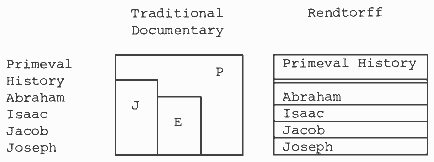
Though at first sight van Seters and Rendtorff are proposing quite different analyses of the Abraham traditions, on one basic point they agree: that the cycle as it stands is a substantial unity whose present shape can be ascribed to one principal redactor. This redactor took over earlier material and integrated into his own scheme. In a recent article[53] on the flood narrative I argued independently of Rendtorff that such a scheme fits Genesis 6 - 9 better than the usual critical supposition of two independent J and P flood stories. It is more congruent with the data to suppose that the flood, story is an essential unity, to be attributed to the editor of Genesis who perhaps adopted a pre-Israelite story and reworked it to
[p.177]
express his own theological understanding of the events. It seems to me very difficult to distinguish between the work of the redactor of Genesis and his source material, unless one supposes he borrowed directly from one of the extant Mesopotamian flood stories.
With the patriarchal narratives it is even more difficult to know where the source ends and the editor begins. Certainly the pervasiveness of the promise themes throughout the patriarchal narratives focuses our attention on the editor's understanding of his material. And it may be that some of the promises do represent editorial additions to the earlier source material, but since these earlier sources no longer exist, dogmatism is impossible. It would seem wiser to begin with the explicit statements of the text about the editor's intentions and not rely merely on conjecture. As far as his treatment of the promises is concerned, the text is silent. But both Exodus 3 (generally assigned to E) and Exodus 6 (generally assigned to P) make explicit reference to the divine names used in Genesis. It therefore seems appropriate to begin our study with an exegesis of these passages.
4.2. The exegesis of Exodus 6:3
Exodus 3:13-15 is translated by the RSV as follows.
Then Moses said to God, 'If I come to the people of Israel and say to them, "The God of your fathers has sent me to you", and they ask me, "What is his name?" what shall I say to them?' God said to Moses, 'I AM WHO I AM.' And he said, 'Say this to the people of Israel, "I AM has sent me to you."' God also said to Moses, 'Say this to the people of Israel, "The LORD, the God of your fathers, the God of Abraham, of Isaac and of Jacob, has sent me to you": this is my name for ever, and thus I am to be remembered throughout all generations.'
Moses' question in verse 13 appears to imply that the people did
not know the name of the patriarchal God of Abraham. The divine answer in verse
14 then gives the personal name of the God of the fathers. However it is not
quite clear whether this name is 'I AM WHO I AM' (Hebrew 'Ehyeh  'ehyeh, verse 14) or Yahweh (verse 15). The latter seems more
likely.[54]
'ehyeh, verse 14) or Yahweh (verse 15). The latter seems more
likely.[54]
Exodus 6:3 clarifies the issue, if the usual translation is correct. 'I appeared to Abraham, to Isaac, and to Jacob, as God Almighty (El Shaddai), but by name the LORD I did not make myself known to them.' In other words the patriarchs knew God as El Shaddai, not as Yahweh. The latter name was revealed first to Moses.
[p.178]
For the student of patriarchal religion it is the second half of
the. verse that is problematic. The Hebrew reads  yhwh
yhwh  .
The Greek and the Latin translate this clause literally: kai to onoma mou
Kyrios ouk
.
The Greek and the Latin translate this clause literally: kai to onoma mou
Kyrios ouk  autois, et nomen meum Adonai non indicavi eis. The older targums render it
equally literally: Onkelos yy
autois, et nomen meum Adonai non indicavi eis. The older targums render it
equally literally: Onkelos yy  ,
Neofiti brm
,
Neofiti brm  tqip' yyy l' '
 lhon. It is apparent then that the early translators took this
verse in its plain and obvious sense, and ignored the fact that several
passages in Genesis imply that God did reveal his name Yahweh to the
patriarchs.
lhon. It is apparent then that the early translators took this
verse in its plain and obvious sense, and ignored the fact that several
passages in Genesis imply that God did reveal his name Yahweh to the
patriarchs.
The later targum,[55] pseudo-Jonathan,
is aware of the problem though. Exodus 6:3 runs: w'tg'liti l'brhm 
 b'
1
b'
1  h' brm b'pe
  1' '
1' ' ihon. (I revealed myself to Abraham, Isaac and Jacob as El Shaddai and my
name Yahweh but in the character of my Shekinah I did not make myself known to
them.) In other words the patriarchs knew the word Yahweh, but did not
experience the glory of the Shekinah usually associated with the name.
ihon. (I revealed myself to Abraham, Isaac and Jacob as El Shaddai and my
name Yahweh but in the character of my Shekinah I did not make myself known to
them.) In other words the patriarchs knew the word Yahweh, but did not
experience the glory of the Shekinah usually associated with the name.
Similarly mediaeval Jewish commentators attempted to solve the
problem by supposing that by his 'name' Exodus 6:3 means some aspect of his
character. Thus though the patriarchs knew the word Yahweh, they did not
understand the character that lay behind this name. This character was first
revealed to Moses. For Rashi, the divine characteristic implied by Yahweh was
the fulfilment of promises. The patriarchs received promises, but did not
experience their fulfilment. For Rambam the difference between God as El
Shaddai and God as Yahweh lay in the difference between the providential power
of God and his miracle-working power. Thus the patriarchs simply experienced
God controlling their circumstances and protecting them in ordinary natural
ways, while Moses experienced supernatural miraculous divine
interventions.[56] The same sort of explanation is
offered by Cassuto.[57] He holds that El Shaddai
refers to God in his character of giver of fertility, since where this term
occurs in Genesis it is attached to promises of being fruitful and multiplying
(e.g. Gn. 17:1-2; 35:11 etc.), whereas Yahweh means that 'He is the One who
carries out His promises'. Some Christian commentators[58] have also held that  (name) really means character and this explains the remarks in Exodus 6:3. The
patriarchs knew the word Yahweh, but did not experience the character implied
by that name. That was first revealed to Moses.
(name) really means character and this explains the remarks in Exodus 6:3. The
patriarchs knew the word Yahweh, but did not experience the character implied
by that name. That was first revealed to Moses.
A second method of eliminating the clash between Exodus 6:3 and Genesis is to suppose that the syntax of
[p.179]
Exodus 6:3 has been misunderstood. W. J. Martin,[59] for example, suggests the clause should not be taken as a statement denying the name Yahweh was known to the patriarchs, but as a question implicitly affirming that they did know him as Yahweh. Verse 3 should then be translated 'I suffered myself to appear to Abraham, to Isaac and to Jacob, for did I not let myself be shown to them by my own name YHWH?' He points out that such an understanding of verse 3 is supported by the following verse which begins (w[e]gam) 'and also I established my covenant'. This implies that the immediately preceding clause ought to be positive, not negative as the usual translation implies. A slightly different interpretation of the syntax of Exodus 6:3ff. is offered by F. I. Andersen,[60] but he arrives at the same conclusion as Martin, namely that the verse is asserting that the patriarchs did know the name Yahweh.
The third method of dealing with the problem, adopted by the great majority of modern commentators, is to appeal to source criticism. They understand the passage in the same way as the ancient versions: that it is denying that the patriarchs knew the name of Yahweh. They claim that the author of this passage, P, could make this assertion because in the P-material in Genesis, God introduces himself to the patriarchs as El Shaddai not as Yahweh. The two P-Genesis passages, where Yahweh is mentioned occur in descriptive narrative description, not in divine speech (17:1; 21:1b).
A fourth possibility is put forward by Childs. He holds that the revelation to Moses involved both the new name and its meaning. In other words he combines the traditional Jewish understanding with the modern critical view. 'The revelation of the name of Yahweh is at the same time a revealing of his power and authority'.[61]
There are difficulties with each of the suggested solutions. The Jewish suggestion that the revelation of the name of God means the revelation of God's character, has problems in defining exactly what aspect of his character is expressed in the term Yahweh. Neither Rashi's explanation (that Moses experienced the fulfilment of the promises while the patriarchs did not), nor Ramban's suggestion (that the patriarchs knew only God's providence) exactly fits the data. The patriarchs did experience a partial fulfilment of the promises in the birth of children and the acquisition of burial grounds in Canaan, while Moses actually died outside the promised land. And while Moses' miracles were more spectacular, the birth of Isaac to an elderly couple seems more than the usual act of providence.
[p.180]
The syntactic solution is beautifully simple, but it is strange that the early translators are quite unaware of it. And the parallel passage in Exodus 3, which suggests that the name Yahweh was new to Moses, also tells against the syntactic solution.
The critical solution, which supposes that Exodus 6:3 is referring only to the priestly source, while solving one problem, creates another. How can the priestly writer who was writing after J have been ignorant of the fact that J uses Yahweh to refer to God and occasionally allows God to introduce himself as Yahweh? The older documentary hypothesis, which held that P was the earliest source and that J was a later source avoided this problem. But by dating P after J, Graf and Wellhausen have created this strange anomaly. If it is held that this verse shows that P was totally ignorant and independent of J, one is still left with the problem of the redactor's understanding of the passage. How did he relate Exodus 6:3 to the statements in Genesis? Some sort of exegetical solution is required to complement the critical understanding of this verse as Childs has rightly seen. However, objections have already been raised to Rashi's exegetical solution, which Childs tries to hold in harness with the critical view.
4.3. Pre-Mosaic knowledge of Yahweh
It could lead to a more objective exegesis of Exodus 6:3 if it could be determined whether the name Yahweh was known before the time of Moses. To this we now turn. The evidence falls into two categories: indirect evidence about the use of Yahweh in pre-Mosaic times and the testimony of Genesis. The indirect evidence all suggests that El was a well-known god in early times, but Yahweh was not. Most of this material has already been discussed; here I shall just recapitulate and add a few extra observations.
The extrabiblical evidence shows clearly that El was the head of
the west Semitic pantheon in the early second millennium BC. This fits in with
reference to El, El Elyon, El Shaddai and so on in Genesis. On the other hand
there are no extrabiblical. texts attesting the name of Yahweh before Moses.
Recently Pettinato[62] has suggested that the texts
of Ebla may include Yahwistic personal names, indicating that Yahweh was known
in their pantheon. However, as Kitchen[63] points
out, the  element in Eblaite names may be just an abbreviation of other names. Archi has
recently expressed a similar view.[64] F. M. Cross
agrees with this, and, having seen a transcription of the term most confidently
asserted to refer to
element in Eblaite names may be just an abbreviation of other names. Archi has
recently expressed a similar view.[64] F. M. Cross
agrees with this, and, having seen a transcription of the term most confidently
asserted to refer to
[p.181]
Yahweh, holds that it is to be read quite differently.[65] Final judgment will have to await publication of the relevant texts, but at the moment there seems little evidence from outside the Bible that Yahweh is a pre-Mosaic name.[66]
Indirect biblical evidence also points in the same direction. Personal names among the patriarchs include several compounded with El, e.g. Ishmael and Israel, but none with Yahweh.[67] Similarly in the lists of tribal leaders in Numbers 1 and 2 there are several names compounded with El and Shaddai, but none with Yahweh.[68] It has sometimes been suggested that Jochebed, Moses' mother (Ex. 6:20) is a Yahwistic name, but this is far from certain.[69] The testimony of Genesis has already been surveyed in the opening section. From this it was clear that the Joseph cycle by restricting Yahweh to the narrative frame-word and using Elohim or El Shaddai in the dialogue suggests that the editor of this section held that the patriarchs did not know the name Yahweh though he believed that he was their God.
In the Abraham and Jacob cycles the picture is not so clear-cut. While Yahweh is more frequent in the narrative framework than in the dialogue, the fact that Yahweh occurs in the dialogue suggests that the patriarchs were familiar with the name. Whether this is a necessary conclusion must now be examined. Passages where two names are used together, e.g. 'Yahweh El Elyon' (14:22) or 'Adonai Yahweh' (15:2) do not need to be discussed, since it seems quite possible that Yahweh has been added to show the identity of the older name with the new name. More problematic are those passages where Yahweh occurs alone.
The evidence for supposing that the editor sometimes introduced Yahweh instead of El or Elohim is quite clear. For example, Hagar is told to name her son 'Ishmael, because the LORD has given heed to your affliction... So she called the name of the LORD who spoke to her, "You are El Roi"' (16:11, 13). Similarly after his vision of the heavenly ladder Jacob awakes and remarks 'Surely the LORD is in this place', yet he goes on to call the place 'Bethel' (28:16, 19). In another encounter with God Jacob's name is changed to Israel and he calls the place Peniel. (32:28, 30). In the last passage it seems probable that an original El has been changed into Elohim, whereas in the first two passages El has been changed into Yahweh. They show at any rate that the narrator felt free to use Yahweh instead of El, not only in his own narrative but when reporting the dialogue of human characters or the angel of the LORD.[70] This is confirmed by an examination of the etymolo-
[p.182]
gies of the patriarchs in Genesis 29:31 - 30:24. Both Elohim and Yahweh are referred to, but the names given are quite unrelated to the title of deity. Within the narrative framework there is a clear tendency to mention Yahweh at the beginning and end of a scene e.g. 12:1,17; 13:4, 18; 18:1, 33, etc. The same tendency is noticeable in passages where Elohim is used in the body of the scene, e.g. 17:1; 20:18; 21:1, 33. It may be that the same logic explains the frequent use of Yahweh in the opening and closing episodes of the Abraham cycle, i.e. chapters 12 and 24.
There are in fact only four passages in the patriarchal narratives where Yahweh speaks and uses this name on its own to describe himself. The first 'Is anything too hard for the LORD?' (18:14) is a proverbial statement cast in the form of a rhetorical question. Here the divine name is quite incidental to the thrust of the question, and therefore it would be unwise to read too much into this passage about the patriarchal knowledge of the name of Yahweh. Likewise though 18:19 mentions Yahweh twice, because it forms part of a divine soliloquy explaining God's motives, this verse does not imply that Abraham either heard these words or knew the divine name.
Much more germane to our discussion is the one other divine speech
which employs Yahweh without any other epithet: 'I am the LORD who brought you
( )
from Ur of the Chaldaeans' (15:7). Other divine revelations mentioning one name
of God refer to him either as El Shaddai (17:1; 35:11) or 'God of your father'
(26:24). The uniqueness of 15:7 suggests there may be a special reason for the
use of Yahweh here. Earlier commentators tended to see verse 7 as an editorial
addition designed to link the two scenes that make up Genesis 15. More recent
studies[71] tend to favour the integrity of verse 7
with what follows.
)
from Ur of the Chaldaeans' (15:7). Other divine revelations mentioning one name
of God refer to him either as El Shaddai (17:1; 35:11) or 'God of your father'
(26:24). The uniqueness of 15:7 suggests there may be a special reason for the
use of Yahweh here. Earlier commentators tended to see verse 7 as an editorial
addition designed to link the two scenes that make up Genesis 15. More recent
studies[71] tend to favour the integrity of verse 7
with what follows.
An examination of the usage of the formula 'The LORD who brought you out' in the rest of the Pentateuch suggests an explanation for the use of Yahweh here. 'The LORD, who brought you out' occurs twenty-two times in the Pentateuch. In every case except this one the reference is to God bringing Israel out of Egypt. It is clear that 'the LORD bringing you out of Egypt' is a stock phrase. It seems likely that the editor of Genesis was wanting to draw attention to the parallel between Abraham's departure from Ur and Israel's exodus from Egypt. He had to substitute Ur for Egypt in the standard formula. If he had also replaced Yahweh, the name for God usually used in the formula, the allusion to the exodus would have become inaudible. He therefore used Yahweh in Genesis 15:7 to make the typological point that the God who brought Abraham out of Ur was the same God who saved Israel from Egypt. So there
[p.183]
is insufficient ground for supposing that here the editor was asserting that Abraham knew the name of Yahweh.
What seems more compatible with the evidence is that the Yahwistic editor of Genesis was so convinced of the identity of Yahweh and the God who revealed himself to the patriarchs,[72] that he not only used Yahweh in the narrative, but also more sparingly in reporting human and angelic speech. He showed even more restraint in modifying divine utterances. Often the old title of God was left unaltered. When the editor wanted to express the identity of the patriarchal God with Yahweh, he usually did it by adding Yahweh to an older epithet. Only in one case does Yahweh replace an older epithet, for which (I have suggested) there is a particular theological reason.
If this is the correct understanding of the Genesis editor's method, it sheds fresh light on Exodus 3 and 6. Taken together these passages do suggest that a genuinely new name of God, Yahweh, was vouchsafed to Moses. And this is the way the ancient translators took it. However, this did not mean that there was a clash with the Genesis traditions, because they are not always verbatim reports of divine revelation. Where it suited his theological purpose the Genesis editor could add and even once substitute Yahweh in the divine speeches. However, the great reserve with which in practice he modified the wording of the speeches of God, as far as the use of the divine names is concerned, could well extend to the promises contained in these speeches. Westermann's hypothesis, which supposes that the promises were added to the tradition with great freedom, becomes somewhat implausible. If, where the editor's method can be checked, it can be shown that he was anxious to be faithful to early tradition, as is the case with the divine names, it is unreasonable to suppose that he acted without regard to the tradition in those areas, such as the promises, where we have no controls. When it is also remembered that it was not unusual for ancient Semitic deities to make such promises as Genesis contains, there is a good case for holding that the religious statements in the patriarchal tradition are just as old as any other part of the stories.
5. SUMMARY AND CONCLUSIONS
Though the sources that describe the patriarchs' religion are not as early or detailed as a religious historian would like, this study has tended to support the main conclusions of modern scholarship about the character of that religion. It involved the worship of the Semitic high god
[p.184]
El, who revealed himself to the leaders of the clans. In so far as the patriarchs generally lived outside the main Canaanite towns, it seems more probable that they first started to worship El in Mesopotamia, not in Canaan. The God of the patriarchs was in a special relationship to their clans: Genesis 15 and 17 describe the relationship as a covenant, which involved promises of divine protection and supplying their needs of land and children. The writer of Genesis identifies the patriarchs' El with Yahweh and prefers to use the latter term when describing divine activity, yet in reporting the words of God to the patriarchs he uses Yahweh very sparingly suggesting that he wanted to transmit the traditional form of the promises, not create divine words ex nihilo.
The patriarchs' response to revelation took the form of the traditional acts of piety, sacrifice, vows, tithes, ritual cleansing, prayer and libations. They are portrayed as men of faith, who obeyed the divine commands and believed his promises. The story of the sacrifice of Isaac which exemplifies these themes may also represent a rejection of child sacrifice, which was a feature of some types of El worship.
The type of religion portrayed in Genesis has many points in common with later Israelite practice, but this is not to prove that the patriarchal stories are simply retrojections of first-millennium ideas into a fictional past. Revelation, prayer and sacrifice are features of most pre-Christian religions. But certain aspects of patriarchal religion are so different from later practice, that to suppose the traditions were invented in the first millennium seems unlikely.
There are at least four striking contrasts between the religion of the patriarchs and later Israelite practice. First, there is the use of the term El instead of Yahweh in divine revelation. From Mosaic times onward Yahweh was the characteristic self-designation of God. But in Genesis God usually reveals himself as El. This distinction between the El revelation of Genesis and the Yahweh revelation of later times is more than a verbal contrast. The exclusiveness, holiness, and strictness of the God of Exodus is absent from Genesis. Though the patriarchs are faithful followers of their God, they generally enjoy good relations with men of other faiths. There is an air of ecumenical bonhomie about the patriarchal religion which contrasts with the sectarian exclusiveness of the Mosaic age and later prophetic demands.[73]
Secondly, the complete absence of Baal from the patriarchal tradition points to its antiquity. In the second half of the second millennium BC Baal took over from El as
[p.185]
the leading god in the west Semitic pantheon, yet he is never mentioned in Genesis. This is intelligible if the patriarchal tradition originated before about 1500 BC, but not if it comes from later times.
A third feature distinguishing patriarchal religion is its unmediatedness. God spoke to the patriarchs directly in visions and dreams, and not through prophets. In their turn they built altars and offered sacrifice themselves without priestly aid. Such religious immediacy fits in with the nomadic way of life of the patriarchs, but is quite different from the religion of the monarchy period where priests and prophets were the usual mediators between God and man.
The final striking difference between the patriarchal period and the first-millennium scene is the non-mention of Jerusalem. The patriarchs worshipped near other great sanctuaries Shechem, Bethel, Hebron and Beersheba, but there is no unambiguous reference to Jerusalem. The town certainly existed in patriarchal times: it is mentioned at Ebla and in nineteenth-century Egyptian execration texts. Psalms 76 and 110 identify Salem (Gn. 14) with Jerusalem, while 2 Chronicles 3:1 identifies Moriah (Gn. 22:2) with Mount Zion. But in Genesis itself there is no hint of these identifications, and this is most easily explained if the patriarchal traditions not only originated, but were committed to writing, before Jerusalem became the principal cultic centre in the time of David.
These features of patriarchal religion are compatible with an early second-millennium date for the tradition, but they would be strange if it grew up in the later monarchy period.
NOTES
[1] This essay was written at the Hebrew University, Jerusalem, during sabbatical leave there supported by a grant from the British Academy. I should also like to thank Professor F. M. Cross and Mr A. R. Millard for advice on several points.
[2] For a thorough survey of German Protestant views in the last 100 years see H. Weidmann, Die Patriarchen und ihre Religion im Licht der Forschung seit Wellhausen (Göttingen, Vandenhoeck and Ruprecht, 1968).
[3] Notes on the table:
-
The Abraham cycles consists of 12:1 - 25:18; Jacob 25:19 - 37:1; Joseph 37:2 - 50:26 (excluding the blessing of Jacob 49:22-27 which is poetry.
-
The bracketed figures in the dialogue column refer to divine speech: the other figure covers human, angelic and divine speech.
-
The references to household gods in 31:19, 30, 32, 34, 35 and 35:2, 4 are not included.
[4] It may be asked why Genesis is so reticent about the religious practices of the patriarchs when the other books of the Pentateuch are replete with cultic details (cf. Ex. 19-40; Leviticus, Numbers, Dt. 12-18). There is a similar contrast between the books of Samuel and Kings on the one hand and the books of Chronicles on the other. The former tend only to mention religious practices in passing, while the latter describe the cult at great length. The reason for this discrepancy is clear. Samuel and Kings were edited in a period when the temple cult had become irrelevant. The bulk of the population was in Babylonian exile and unable to worship in the temple. The author of Kings regarded it as more important to explain the reasons for the exile than to recall nostalgically the elaborate temple rituals which it was no longer feasible to carry out. The author of Chronicles on rhe other hand was writing in a different situation, when many of the exiles had returned and the temple had been refounded. In order to encourage them to offer worship worthy of almighty God, he described at length the glories of the first temple in the hope that they would try to emulate the dedication of David, Solomon, Hezekiah and Josiah. It could be that a similar logic underlies the sparse details about worship in Genesis. Normal national worship is described in Exodus to Deuteronomy. The individualistic worship of the patriarchs without the aid of priests and prophets differed from later practice to much a degree that it is by and large passed over.
[5] Notes on the table:
-
Chapters 14 and 49 are omitted from this analysis.
-
The source analysis is that of S. R. Driver, An Introduction to tho Literature of the Old Testament (Edinburgh: Clark, [9]1913).
[6] Genesis 12 - 50 about 630 verses are assigned to J. about 390 verses to E, and about about 220 to P.
[7] E.g. L. Rost, 'Die Gottesverehrung der Patriarchen im Lichte der Pentateuchquellen', VT Supp.7, 1960, p.350; S. E. McEvenue, The Narrative Style of the Priestly Writer (Rome: Biblical Institute Press, 1971); F. M. Cross, Canaanite Myth and Hebrew Epic (Cambridge, Mass.; Harvard UP, 1973), pp.294-295.
[8] E.g. L. Rost, VT Supp.7, 1960, p.350.
[9] A. Alt, Der Gott der Väter (Stuttgart: Kohlhammer, 1929) reprinted in KSI (Munich: Beck, 1953), pp.1-78, ET by R. A. Wilson in A. Alt, Essays on OT History and Religion (Oxford: Blackwell), 1966), pp.3-77. Quotations are from this English edition.
[10] Ibid. pp.16, 19.
[11] J. Lewy, 'Les textes paléo-assyriens et l'A.T.', Revue de l'histoire des religions 110 (1934), pp.29-65.
[12] Summarized by F. M, Cross, Canaanite Myth and Hebrew Epic, pp.10-11.
[13] See especially the essays of O. Eissfeldt in the bibliography and the work of Cross to be discussed next.
[14] In Harvard Theological Review 55, 1962, pp.225-259.
[15] In F. M. Cross, Canaanite Myth and Hebrew Epic (Cambridge, Mass.: Harvard UP, 1973), pp.3-75.
[16] HTR 55, 1962, pp.228f.
[17] Canaanite Myth, pp.10f.
[18] HTR 55, 1962, p.231.
[19] Cross regards the
definite article in Gn.46:3  as
secondary, dating from a period after the spelling was modernized and the
definite article introduced in about the tenth century BC. HTR 55, 1962,
p.232 n.27.
as
secondary, dating from a period after the spelling was modernized and the
definite article introduced in about the tenth century BC. HTR 55, 1962,
p.232 n.27.
[20] HTR 55, 1962, p.236.
[21] ' 'elyôn also occurs in Ps. 78:35, 'an early context'. Canaanite
Myth, p.52 n.29.
'elyôn also occurs in Ps. 78:35, 'an early context'. Canaanite
Myth, p.52 n.29.
[22] HTR 55, 1962, p.244.
[23] HTR 55, 1962, p.245; cf. M. H. Pope, El in the Ugaritic Texts (VT Supp.2, Leiden, Brill, 1955), pp.61f.
[24] Canaanite Myth, pp.57ff., adopting with soon modification the suggestions of L. R. Bailey; JBL 87, 1968, pp.434-438; and J. Ouellette, JBL 88, 1969, pp.470f.
[25] Canaanite Myth, p.15.
[26] E.g. M. N. Pope, El in the Ugaritic Texts, pp.55-58; R. Rendtorff, 'El, Baal and Jahwe', ZAW 78, 1966, pp.277-291; R. de Vaux, Histoire ancienne d'Israel (Paris; Lecoffre, 1971), p.262.
[27] R. Lack, 'Les origines de Elyon, le très-haut, dans la tradition cultuelle d'Israel', CBQ 24, 1962, pp.44-64.
[28] J. Ouellette, 'More
on 'Êl  and Bêl
  ', JBL 88, 1969, pp.470-471.
[29] Histoire ancienne, p.264.
[30] Canaanite Myth, pp.57-60 and 57 n.52.
[31] L. R. Bailey,
'Israelite 'El Sadday and Amorite Bêl ,' JBL 87, 1968, pp.434-438.
[32] E.g. Sarai,
Milchah, and Terah:  //
// (Sin's wife) ,
  //malkatu (Sin's daughter), terah//Ter (a name of Sin //
 (moon). E. L. Abel, 'The Nature of the Patriarchal God '
 ', Numen 20, 1973, pp.48-59.
[33] K. Koch, ' ', VT 26, 1976, pp.299-332.
[34] Koch suggests this verse is a P-influenced insertion into a JE context, VT 26, 1976, p.304 n.7. Since he admits the antiquity of the poetic passages, this looks like special pleading. Some divine name is required in this verse.
[35] See J. J. M. Roberts, The Earliest Semitic Pantheon (Baltimore: lohns Hopkins UP, 1972), p.34: 'The picture, then, that the Old Akkadian names give of Il is a portrait of a high, but gracious god, who is interested in man's welfare, and who is particularly active in the giving of children.' On Il at Ebla see G. Pettinato, BA 39, 1976, pp.48-50.
[36] From a theological standpoint it may seem easier to regard Abraham as a worshipper of El, the high creator god of the Canaanite pantheon, than as a devotee of the moon god. However, El's character had a much seamier side; for example child sacrifice was frequently associated with his cult (Cross, Canaanite Myth, pp.25ff, cf. Gn. 22).
[37] M. Haran, 'The Religion of the Patriarchs', ASTI 4, 1965, pp.30-55.
[38] Haran, p.42, ascribes Baalam's use of the term El Shaddai and its frequency in Job to its currency outside Israel.
[39] See Canaanite Myth, pp.294f.
[40] The later work includes a repcrint of the former. My reference to Arten der Erzähleng are for convenience all taken from Die Verheissungen.
[41] Verheissungen, p.39 n.23.
[42] Ibid., pp. 18ff. The promises of numerous descendants and blessing are never found alone, always in combination with other promises.
[43] Ibid., pp.19f.
[44] Ibid., pp.29ff.
[45] Ibid., pp.25f.
[46] Ibid., p.74.
[47] V. Maag, 'Der Hirte
Israels', Schweizerische Theologische Umsehau 28, 1958, pp.2-28;  Jhwh', VT Supp.7, 1960, pp.129-153, esp. 137-142.
[48] Verheissungen, pp. 118f.
[49] J. van Seters, Abraham in History and Tradition (New Haven: Yale UP, 1975).
[50] O. Eissfeldt, 'Der Kanaanäische El ais Geber der den israelitischen Erzvätern geltenden Nachkosvsenschaft-und Landbesitzverheissongen', KS 5, 1973, pp.50-62.
[51] H. Cazelles, Dictionnaire de la Bible Supplément 7 (Paris: Letouzey, 1966), pp.144-145.
[52] Verheissungen, p.110.
[53] G. J. Wenham, 'The Coherence of the Flood Narrative, VT 28, 1978, pp.336-348.
[54] See R. de Vaux, 'The Revelation of thc Divine Name YHWH', in J. I. Durham and J. R. Porter (eds.), Proclamation and Presence: OT Essays in Honour of G. H. Davies (London: SCM, 1970).
[55] The dating of the targums is very difficult. Pseudo-Jonathan contains both pre-Christian and post-Islamic traditions, so its tina( redaction must be late.
[56] See N. Leibowitz, Studies in Shemot I (Jerusalem: World Zionist Organization, 1976), pp.132-135.
[57] U. Cassoto, A Commentary on the Book of Exodus (Jerusalem: Magnes, 1967), p.79.
[58] E.g. C. F. Keil, Exodus (Biblical Commentary), ad loc. J. A. Motyer, The Revelation of the Divine Name (London: Tyndale, 1959).
[59] Stylistic Criteria and the Analysis of the Pentateuch (London: Tyndale, 1955), pp.18f., followed by G. R. Driver, Journal of the Ancient Hear Eastern Society of Columbia University 5: The Gaster Festschrift (1973), p.109.
[60] Sentence in Biblical Hebrew (The Hague: Mouton, 1974), p.102.
[61] B. S. Childs, The Book of Exodus (Philadelphia: Westminster, 1974), p.113.
[62] G. Pettinato, 'The Royal Archives of Tell Mardikh-Ebla', BR 39, 1976, p.48.
[63] K. A. Kitchen, The Bible in its World (Exeter: Paternoster, 1977), p.47.
[64] A. Archi, Biblica 60, 1979, pp.556-560.
[65] In a personal conversation.
[66] Some discussions of the Ugaritic and Mari materials also suggested that Yahweh was mentioned in them, but this has now been generally rejected. See R. de Vaux, 'The Revelation of the Divine Name YHWH', in Proclamation and Presence, pp.52-56.
[67] On Judah see A. R.
Millard, 'The Meaning of the Name Judah', ZAW 86, 1974, pp.216-218, who
suggests it may be an abbreviation of  or
or  . In the light of the other evidence, I prefer the second
possibility.
. In the light of the other evidence, I prefer the second
possibility.
[68] Though these are attributed to P, the forms of the names are characteristically second-millennium. Cross, Canaanite Myth, p.54.
[69] Most recently by M. Haran, ASTI 4, 1965, p.51 n.33. For a different view see M. Noth, Die israelitischen Personennamen (Stuttgart: Kohlhammer 1928), p.111 and R. de Vaux, Proclamation and Presence, p.49.
[70] Cf. O. Eissfeldt, KS 5, pp. 52ff.
[71] E.g. G. von Rad, Genesis: A Commentary (Philadelphia: Westminster, 1961), p.l85; R. E. Clements, Abraham and David (London, SCM, 1967), p.21; N. Lohfink, Die Landverheissung als Eid (Stuttgart, Katholisches Bibelwerk, 1967). C. Westermann, Genesis 12 - (Biblischer Kommentar, Neukirchener Verlag, 1979), pp.255-256.
[72] This could be the point made by Gn. 4:26 'At that time men began to call on the name of the LORD, which may be paraphrased, 'Then the worship of the true God began.' C. Westermann, Genesis 1-11 (Biblischer Kommentar, Neukirchener Verlag, 1974) pp.460-463, insists that this verse is tracing the origins of worship to the primeval period, and does not necessarily indicate that the divine name Yahweh was known then.
[73] B. Gemser, 'God In Genesis', OTS 12, 1958, pp.1-21.
© 1980 A.R. Millard & D.J. Wiseman, reproduced by permission. Prepared for the web by Robert I. Bradshaw, January 2004. Please report any typographic errors.