






Theology on the Web helps over 2.5 million people every year to find high quality theological resources that will help to equip them to serve God and to know Him better (2 Timothy 2:15). Like other websites that provide free services, it is dependent on donations to enable it to grow and develop and only 0.004% of visitors currently do so. If you would like to support this site, please use one of the options to the right of this message.
The Tyndale Biblical Archaeology Lecture, 1959
This lecture was delivered in Cambridge on July
2nd, 1959
at a meeting convened by the Tyndale Fellowship for Biblical
Research.
[p.3]
Some very distinguished scholars believe there has never been such a thing as an Exodus of Israelites out of Egypt and for these, of course, there are no problems, no problems of dates and no problems as to the route followed. However, most specialists today do believe that there were Hebrews in Egypt and that at one time these left the eastern Delta.
Many different texts from the Bible mention this Exodus, and the Egyptian tradition as remembered by Manetho does not ignore the fact. However, critics disagree widely when it comes to interpreting the passages mentioning this Exodus. Three sets of facts have to be taken into account: (1) the geography; (2) the facts of archaeology; (3) the facts of biblical criticism. None of these can be ignored.
I shall confine myself to an examination of the date and to a very cursory glance at the route of the Exodus as seen by an Egyptologist.
The Date Of The Exodus
Let us first examine what the Bible has to say on the subject. According to 1 Kings vi. 1, Solomon built the temple of Jerusalem 480 years after the coming out of the children of Israel from the land of Egypt.
According to Exodus xii. 40 the sojourn of the Hebrews in Egypt had lasted 430 years. This detail of Israelite tradition is confirmed by Genesis xv. 13 (RSV) where Jahweh predicted to Abraham: 'Know of a surety that your descendants will be sojourners in a land that is not theirs, and will be slaves there, and they will be oppressed for four hundred years.'
However, even inside Jewish tradition this figure of 430 years
[p.4]
in Egypt has received various interpretations. Flavius Josephus, in his Antiquitatum Judaicarum, II. xv, 2, makes this date count from the arrival of Abraham in Ganaan, en route for Egypt. He says: 'They left Egypt in the month of Xanticos, at the neomenia, in the 430th year after the arrival of our patriarch Abraham in Ganaan and in the 215th year after that Jacob had come to Egypt.' And if we turn to Exodus vi. 14-25, we see that Moses only mentions four generations.
Two theories of Exodus have been advanced to make Jewish tradition fit with the history of Egypt.
The theory of an Exodus during the reign of king Amenophis II is the more recent one. It goes back to Lefébure who produced it in 1896 and it was diffused much later among the Roman Gatholic exegetes by Mallon in his memoir Les Hébreux en Egypte, published in 1921. Feet adopted the same view in his book Egypt and the Old Testament, published in 1922. More recently Sir Charles Marston, commenting on the excavations of Garstang at Jericho, took up this theory and defended it with excessive zeal.
According to the defenders of this theory, it suffices to apply what they call biblical chronology to Egypt to have everything work out smoothly.
Indeed, if we go back 480 years from the construction of the temple at Jerusalem, which took place in approximately 960, we come to the date of 1440, which is year ten of Amenophis II (1450-1425 BC). This would give us the date of the Exodus.
The pharaoh who died during the stay of Moses in Midian (Exodus ii. 23) would then be Tuthmosis III, who died in 1450.
The entry of the Israelites into the land of Canaan after forty years in the desert would then have taken place about 1400, in the middle of the reign of Amenophis III (1408-1372 BC). It is at this time that the capture of Jericho should then be placed. Moses died immediately before this (Dt. xxxi. 2, xxxi. 5) at the age of 120 years. He was therefore born towards 1520, at the end of the reign of Tuthmosis 1 (1530-1520 BC), whose daughter Hatshepsut had taken the young Moses and had him educated as her son. The flight to Midian, at the age of forty, is best explained by the death of Hatshepsut, after which event Tuthmosis III persecuted Senenmut, the architect of the queen, and all those whom the queen had favoured.
The defenders of this theory find confirmation in the fact that
[p.5]
Garstang has proved, so they imagine, that the city of Jericho had been destroyed by violence in the time of Amenophis III. In the burned out town, carbonized provisions have been found and the tombs of the necropolis have yielded no scarabs which are later than Amenophis III. These facts would date the destruction of the city. We may recall, however, that according to Joshua vi. 18, 19, 24, all the metal objects had been collected for the treasury of the house of Jahweh. Those who hold this theory say, moreover, that it was inevitable that the Hebrews who descended into Egypt with the Hyksos, should have followed the latter closely after their expulsion.
Letters of Asiatic kings such as Abdikhiba, governor of Jerusalem, addressed to Amenophis III at Amarna which call for aid against the incursions of a people called Habiru are cited in favour of this. Philologically and historically, it is contended, everything leads one to believe that these were the Hebrews of Joshua penetrating into Canaan.
Finally the stele of year five of Merneptah mentions Israel amongst the populations of Palestine, which is held to prove that Israel was well established there and that the Exodus was long past.
Those who champion the early date advance, furthermore, a tradition of Manetho, which places the Exodus under a king Amenophis. The name of Ra'amses given to a city mentioned in Exodus i. 11 would in this case be a later addition (see below). The same reasoning is used to account for Genesis xlvii. 11, where it is said that Joseph established his brothers in the land of Ra'amses.
The opposing theory, which places the persecution of the Hebrews under Ramesses II (1301-1235 BC) and the Exodus under his son Merneptah (1234-1224 BC) is the oldest one in Egyptology. It was formulated by Lepsius in 1849, was taken up by de Rouge in 1867, by Chabas in 1873, and also by Flinders Petrie in his work Egypt and Israel, published in 1911. To mention a more recent view, in 1949 Berrthardt Grdseloff declared himself a staunch supporter of this theory.
Those who hold this view refer to Exodus i. 11, where it is said that the Hebrews built for pharaoh the store-cities of Pithom and Ra'amses. This city of Ra'amses is known from Egyptian sources as Pi-Ramses, the House of Ramesses, the favourite
[p.6]
residence of Ramesses II in the Delta. Excavations have shown that the kings of Dynasty XVIII (i.e. the Dynasty of Tuthmosis and Amenophis) did no building in the eastern part of the Delta, where Pi-Ramses has to be located. Scholars formerly placed this town at Pelusium, but on geographical grounds, even Sir Alan Gardiner has had to admit that the location of Tanis, as proposed by Montet, is more probable. We have therefore to take the Bible as it stands and since Hebraic tradition links the Exodus with the building of these cities, we must recognize that by this very fact, the Exodus is in some way related to Ramesses II.
It is different in the case of the phrase 'in the land of Ramesses' mentioned in the story of Joseph in Genesis xlvii. 11. Here one has to admit that the language used is that of the time when Genesis was written. However, if we compare this passage with the Septuagint Version of Genesis xlvi. 28, 29, where the phrase 'land of Ramesses' is missing in the corresponding Massoretic Text, we gain the impression that in the case of the first passage too, this is a later gloss added to the original text.
If the persecutor of the Jews was Ramesses II, it was this pharaoh who died during the exile of Moses in Midian (Exodus ii. 23). His successor, Merneptah, finds himself ipso facto designated as the pharaoh of the Exodus, which must have taken place early in his reign, before the stele of year five was set up. This gives a date for the Exodus of about 1230.
We must also note that a period of weakness in Egypt at the end of Dynasty XIX and under Dynasty XX, coinciding with the decadence of the Hittite Empire, explains how in the time of Joshua and the Judges, Israel managed to seep through into Canaan and to conquer it without having to fight there either the Egyptian or the Hittite masters.
In the story of Exodus, it is clear that the pharaoh with whom Moses came so easily in contact could have lived only in the eastern Delta. This happened only during Dynasty X1X. The Hebrews, crossing Transjordan, found there the kingdoms of Moab and Edom, which were only created in the thirteenth century.[2] Furthermore, the excavations in Palestine have shown
[p.7]
that the civilization of the late Bronze Age, that of the Old Ganaanites, existed there until the end of the thirteenth century.[3]
The main difficulty involved in accepting this theory of an Exodus under Merneptah is the deliberate sacrifice one would seem to make of the chronology indicated in the first book of Kings (vi. 1).
The excavations of Jericho also have to be taken into account. We now know that Garstang conducted his excavations without adequate care and jumped to conclusions. He wanted to find the Jericho of Joshua and interpreted the evidence in order to obtain this result. We know today that the layer in which the Jericho of Joshua should have been found has completely disappeared, unless it exists in one of the other tells which have not been excavated. It seems as if Garstang was looking for Jericho in a place where it never was.
To return to a more critical examination of the early dating, it seems that the theory of an Exodus under Amenophis II is also subject to grave difficulties.
The foundation of this theory, the figure of 480 years before the construction of the temple of Jerusalem, is not unassailable. It is established by the readings of the MSS, but such people as Couroyer[4] and Drioton have remarked that even so it could simply be a symbolical number, part of those symmetrical schemes into which the Orientals try to fit the facts of history.
So, for instance, in Matthew i. 17, the genealogy of Jesus is divided into three equal sections of fourteen generations: one going from Abraham to David, one from David to the deportation to Babylon, the third from the deportation to the birth of Jesus.
In the case with which we are occupied, the period of 480 years corresponds to twelve generations of high priests of forty years each.
[p.8]
Placing Exodus 480 years before the building of the temple, one has twelve generations of high priests between the erection of the tabernacle - a prefiguration of the temple - in the desert, and the realization of the temple. We also count another twelve generations, or the same period of 480 years, between the construction of the temple and its restoration by Zerubbabel. One can even question the meaning of the period of 430 years in Exodus xii. 40, for if we complete this with the interval of fifty years between the construction of the altar of Bethel by Jacob (Gn. xxxv. 1-3, xxviii. 18), and the descent of Jacob into Egypt, we find the same period of 480 years, or another twelve generations, between the building of the first altar and the installation of the tabernacle.
One should not say that such a chronology is void of objectivity, but systematized in this manner, it can only give us an approximation. (We do not expect to find the Bible a treatise on astronomy or on geography, nor should we expect it to be a modern treatise of historiography.)
A second difficulty is that if the facts of the Exodus accord so well with the general policy of the first kings of the Dynasty XVIII, which was to deliver Egypt from the Hyksos, how are we to explain pharaoh's unwillingness to let the Hebrews depart? Moreover how are we to explain the fact that the Hebrews seem to have been on good terms with the Egyptian population, seeing that the latter willingly lent them jewels and clothes (Ex. iii. 21, 22, xi. 2 and xii. 35, 36). This policy, inexplicable at the time of the Amenophids and Tuthmosids, was on the other hand quite consistent under the Ramesside kings, who welcomed Asiatic workers and needed them.
If the Habiru mentioned in the letters of Abdikhiba, governor of Jerusalem, are the Hebrews of Joshua, it is striking to note that the names of the Palestinian chiefs mentioned in the Bible do not correspond with those of the Tell el-Amarna tablets.
Moreover, we get the impression that things have changed. At the time of the Tell el-Amarna tablets, the Canaanite princes wanted to become free and were trying to augment their territory at the expense of one another, using various armed bands. At the time of Joshua, on the other hand, they were independent and they made a coalition to oppose the Hebrew invaders. Another fact worth noting is that Judges never mentions any Egyptian authority or protectorate in Palestine.
[p.9]
To conclude, the Amenophis quoted by Manetho, according to Josephus (Contra Apionem I, 227-277) is, in the Manethonian List compiled by Eusebius, the fourteenth and last king of Dynasty XVIII, coming after a Ramesses - that is, Ramesses I - and immediately before Sethos - that is Sethos I. This is not favourable to an Exodus taking place early in the dynasty. Josephus even accuses Manetho of having invented this king. Recently, Montet has demonstrated that we have to do with a transposition of an Egyptian tale relating to the War of the Impure Ones, which comes much later, towards the end of Dynasty XX, round about the year 1100. The Amenophis in question would then be no other than the high priest of Amon, Amenophis, who exercised almost royal powers under Ramesses IX. Nobody would ever have related this story with the Exodus, if Manetho, accused of anti-semitism by Josephus, had not added, in naming the head of the revolution: 'He changed his name and had himself called Moses.' It is quite probable that the real Moses has nothing to do with this.
More recent documents in this matter are the stele of Israel and new Egyptian references to the 'Apiru.
The Stele of Israel was discovered in 1895 by Flinders Petrie in the ruins of the temple of Merneptah in western Thebes. It is a long court poem celebrating the victory over the Libyans and the word 'Israel' occurs there quite incidentally. The conclusion of this poem describes the consequences of the defeat of the Libyans. The peoples of Asia, near to Egypt, are struck by terror and make their submission to the Egyptian king:
The princes are prostrate, saying: Salaam!
There is not one who holds up his head among the Nine Bows;
Since the Libyans are defeated, the land of the Hittites is in peace;
Canaan is purged from every evil;
Askalon is conquered; Gezer is held;
Yenoam is made as a thing not existing;
Israel is destroyed: it has no corn;
Khor is as a widow relatively to Egypt;
All lands are united in peace;
Every brigand is subdued.[5]
[p.10]
Some scholars have seen in this description an allusion to a campaign of Merneptah in Palestine. This is uncertain though possible.[6] The text may simply mean that from then on all war was useless in this region. Peace reigned there, thanks to the prestige of Egypt established by the defeat of the Libyans.
A number of scholars have read: 'Israel is destroyed, her seed is not', by which they understand the word 'seed' to mean 'offspring'. There is, however, no ground for this reading. The determinative is a corn of wheat with the three strokes of the plural and Spiegelberg has rightly translated it from the beginning. Besides, this sentence is a cliché which one finds again in the inscriptions of Ramesses III, this time applied to the Libyans: 'Their cities are in ashes, destroyed, utterly ransacked: they have no more grain.' From the Egyptian point of view, people who fled into the desert without taking provisions with them were doomed to destruction.
One has also to observe that the determinative given in the stele of Merneptah to the name Israel differs from that given to the other peoples and countries. All the other place names are marked by the determinative of the sign for 'foreign country'. The name Israel has as a determinative a seated man and wife followed by the three strokes of the plural. It is a determinative which points to a people without reference to a territory. We may perhaps get some information from the order in which these countries are named on the stele.[7] They seem to be named in an order going from north to south, and from south to north inside each subdivision. So one must conclude that Israel is mentioned as a people at the frontier of Egypt. The stele could have been erected only a short while after the Hebrews left Egypt and one does not need to postulate a delay of forty years.
This is not the place to go into the much debated question of
[p.11]
the Hapiru. A long time ago scholars had admitted that this word, which appears frequently in Babylonian texts from the time of Hammurabi, corresponds phonetically to the 'Ibrim or Hebrews of the Bible and to the 'Apiru of the Egyptian texts.
In 1943, Ahmad Badawy published a historical stele of Amenophis II, where the king relates his campaigns of years seven and nine in Asia. Among the prisoners of war we find 3,600 'Apiru, 15,200 Shasu and 36,300 Khurites. More recently, in 1952, Säve-Söderbergh has found 'Apiru being used as workmen in the vineyards in Theban inscriptions dating from Tuthmosis III. In the meanwhile, in 1949, Grdseloff published a very mutilated stele coming from Beth She'an, mentioning an attack of 'Apiru against a city to the west of Jordan, in the reign of Sethos I.
The conclusion of the discussions which have been raging around these 'Apiru is that they neither form an ethnic group nor a territory. This word simply serves to denote the semi-nomadic tribes in the deserts of the Near East, no matter what their race. Today we would call them displaced persons. In short, while the Hebrews formed part of the 'Apiru, it is going against all evidence to call all 'Apiru Hebrews.
Grdseloff had too daringly linked the 'Apiru of the stele of Amenophis II with the entry into Egypt of Jacob and his kindred. He then adopted Josephus' figure of 215 years for the Hebrew sojourn in Egypt, and so placed the Exodus in the last year of Ramesses II. Grdseloff placed Jacob's entry into Egypt and the Exodus at 1438 BC and 1223 BC respectively, using M. B. Rowton's former scheme of dates;[8] 1450 and 1235 BC would be the corresponding dates on those of Drioton-Vandier used here.
The result of the excavations of Montet at Tanis or Pi-Ramses is
quite favourable to the defenders of an Exodus under Merneptah. No trace of
activity of the kings of Dynasty XVIII has been found there. Pi-Ramses seems to
have been the creation of Ramesses II and nobody else. I would like to recall
that Psalm lxxviii. 12, 43 also places the events preceding the Exodus, at
Tanis ( o'an).
[p.12]
[p.13]
The Route Of The Exodus
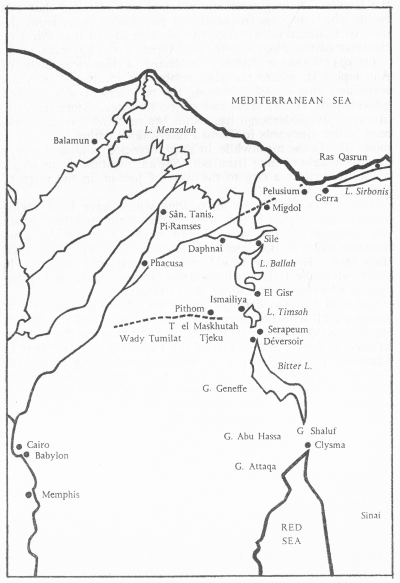
It is with the excavations of Naville at Tell el Maskhutah and the
works of Brugsch and Lepsius that Egyptology began to have a say in the matter.
Up to then one had only an uncertain Judeo-Christian tradition to go by.
Josephus[9] had proposed a very weird itinerary,
making the Jews leave from Letopolis (which he identified with the Egyptian
Babylon = Old Cairo) and directing them to Baalsaphon, which he placed on the
Red Sea. Etheria, Pierre Diacre and Antonin de Plaisance knew about a passage
of the Hebrews at Clysma, near the actual Suez. Lepsius himself rallied to this
view in an article in the Zeitschrift für ägyptische Sprache in 1883. A little before, Brugsch, following Schleiden,[10] had written a book on the Exodus[11] in which he equated the lam-Suf of the Massoretic Text
with the Egyptian pa rjuf. However, he placed this pa tjuf in the
Sirbonis lake, east of Pelusium. One must remember that suf occurs in no
other Semitic language and that phonetically this corresponds to the Egyptian tjuf. The Arabic uf al-babr which means 'wool of the sea',
used of seaweeds, is a metaphor and is therefore no useful comparison. Besides,
this word would have given Hebrew uf. In papyrus Anastasi
III, 2, 11, 12, in a eulogy of Pi-Ramses, we read that 'the papyrus marshes
(pa tjuf) come to him with papyrus reeds and the waters of P-shi-Hor
with rushes.[12] Gardiner locates this in the
Menzalah region and concludes that the compiler of Exodus had a northern route
in mind. In Exodus ii. 3 and 5, suf means plants growing near water,
likewise in Isaiah xix. 6. In The Blinding of Truth,[13] the Nile-valley is compared to a gigantic ox 'standing
in Panamun (Balamun) and the tip of its tail resting upon pa tjuf (the
papyrus marshes)'. This would refer to the swamps between that northern town
and the sea.
Brugsch situated Pi-Ramses at Tanis, that is to say Sân el Hagar. From there the Hebrews should have gone to Etham, which Brugsch located in Daphnai. Migdol is the Magdolum of the Itinerarium Antonini, at twelve Roman miles from Pelusium.
[p.14]
Pihahiroth is then to be sought in the depression of Lake Sirbonis and Baalsaphon must be looked for at Mount Casios, at Ras Qasrun.
These views are hardly reconcilable with the Bible, as Exodus. xiii. 17 tells us that the Hebrews did not take the road of the Philistines, but that God made them turn and go a long way off the shortest road, through the desert. Now the route proposed by Brugsch is exactly that which leads to Gaza and the Philistine cities. Moreover, Mount Horeb is situated by Deuteronomy i. 2 at eleven days' walk from Qadesh and according to I Kings. xix. 8 it took Elijah forty days to reach it, after having passed through Beer-sheba. Thus, at the time of the monarchy in Israel there existed a tradition which placed Sinai in the south of the Peninsula and in the fourth century AD we find Christian ascetics such as Ammonius and Nilus established there.
The theories of Brugsch did not satisfy everybody, however, and in 1900, Lagrange was looking in the south for the biblical toponyms. He preferred to look for Ra'amses near Phacusa. After Müller,[14] he placed the first stop of Succoth at Tjeku, in the eastern part of the Wady Tumilat 'towards Ismailia or el Gisr'. Lagrange favours the suggestion that Etham is the Egyptian htm, which means fort. Pihahiroth would be the Piqerehet of Naville, near Pithom. Migdol would be the Migdol of papyrus Anastasi, near Succoth, and would correspond to the Migdol placed by Maspero near the Serapeum. Baalsaphon would be identified with Serapeum. lam-Suf is neither the Mediterranean nor the Red Sea, both called the Great Green, but the Bitter Lakes, possibly the Kem-Ur of the tale of Sinuhe, already united by a canal to the Red Sea in the time of Sethos I.
In later years we have the works of Clédat and Küthmann.[15] The main point was to know whether the Red Sea reached Wady Tumilat in Roman times. Küthmann concluded that it did not. Wady Tumilat had as a capital Tjeku of the Egyptian papyri. The frontier-city is Sile (Tjaru in Old Egyptian), residence of Horus of Mesen, venerated there as a lion. In the Ancient Egyptian Onomastica, Sile comes after Tanis and Pa-Tjuf. It is probably the Zilu in the Amarna letters, Sile in Itin. Antonini, Sélè as an episcopal see in Coptic times.
By its precise discussion of the classical geographers (Agatar
[p.15]
chides, Eratosthenes, Diodoros, Strabo, Ptolemy, Herodotos) and the Egyptian documents (papyrus Anastasi, geographical lists of Dendera and Edfu) this study was a marked step forward.
The works of Clédat are of another order. Clédat was an archaeologist who dug in Egypt. In 1904, he was at Ras Qasrun, the traditional Casjos; in 1905 and 1909, he worked at Mehamdiah (the Greek Gerra) and he found a temple of Zeus Casios at Pelusium. He also made a sounding at Tell el Her (probably the Migdol of the Prophets: Jeremiah xliv. 1 mentions four communities of Jews in Egypt, viz, from north to south: Migdol, Tahpanhes (Daphnai), Noph (Memphis), Pathros (Pa-ta-rsy or Land of the South), and studied Qatia and Qantara (Sile). In the south he found a fort or temple dedicated to the goddess Hathor, at Djebel Abu Hassa not far from the Bitter Lakes. This he immediately identified with Pihahiroth, but he failed to make any reliable synthesis of his finds.[16]
The synthesis was to be made by Mallon and Gardiner, who adopt widely different views. Both Gardiner and Mallon place Ra'amses at Pelusium. For Mallon[17] the identification of Succoth with Tjeku is pure hypothesis. Etham is even more difficult to locate. Mallon distinguishes two Migdols: a Migdol of the north known of the prophets; a Migdol of the south known by papyrus Anastasi V. The author rejects the Pi-Qerehet of Naville for Pihahiroth, as well as the Pihaherot proposed by Daressy.[18] He does not think much of the Pi-Hathor of Clédat. He seems to favour the location of Baalsaphon in the Gebel Attaqa, but would prefer to seek this on the Asiatic side. For him lam-Suf is the Red Sea and he does not even mention the pa-tjuf proposed by Brugsch.
Gardiner, in his geography of the Exodus,[19] reacts against the conclusions of Mallon. At that time, Gardiner still placed Ra'amses at Pelusium. He admits the equation Suf=TjuI, but for him this cannot be the Red Sea, as reeds do not grow in the sea. He takes it to be Lake Menzalah in the north. For Gardiner the Migdol of Exodus is the same as the Migdol of the prophets and should be located at Tell el Her. Baalsaphon must be in the
[p.16]
north also. Gardiner abandons the equation Tjeku=Succoth, not on philological grounds, but in function of the location he gives to Pelusium and the route he assigns to the Israelites. He does not know what to do with Etham. Neither of these syntheses could satisfy the biblical scholar.
Under the impulse of Bourdon new excavations were made in the southern part of the isthmus, and in 1928 Riff found a Ramesside monument at Serapeum. Bruyere also found a Roman-Byzantine monument at a place he calls Déversoir. In 1930-32, the latter dug at Clysma and reached the level of Ptolemy Philadelphos.
The excavations at Ras Shamra gave new details on Baalsaphon and
Eissfeldt immediately drew conclusions relating to the Exodus. After
Brugsch-Lepsius and Gardiner-Mallon, we find a new antithesis, that of
Eissfeldt-Bourdon. Bourdon[20] first hesitated
between a crossing at Clysma and a passage south of the Bitter Lakes. He chose
the latter in 1932, basing his conclusion on an article by Daressy. This is how
he reasoned: The Israelites made their camp in the land of Goshen, the western
part of Wady Tumilat, around Pithom and Saft-el-Henneh, a region which was only
fortified by Ramesses. They left it for Succoth, that is to say Tjeku, the
eastern part of the Wady Tumilat. Here they fell on Etham, in which Bourdon
sees the htm of Tjeku which he situates at the Serapeum. Scholars have
proposed to locate Etham in several places. Muller wanted to connect it with
the name of the Egyptian god Atum, while Naville had proposed Edom. As this
fort bars their passage to the desert, they go along the Bitter Lakes at the
foot of Gebel Geneffe, to reach Pihahiroth in which Bourdon recognizes the  enit-ta-ert, read by Daressy on a Cairo Papyrus. Migdol is
then the Migdol of Clédat and, following Lagrange, Bourdon sees in a
stele mentioning Seth the evocation of Baalsaphon.
enit-ta-ert, read by Daressy on a Cairo Papyrus. Migdol is
then the Migdol of Clédat and, following Lagrange, Bourdon sees in a
stele mentioning Seth the evocation of Baalsaphon.
It was precisely the localization of Baalsaphon which, in the same year, led O. Eissfeldt towards another solution.[21] The first Ras Shamra texts had just become known from the studies of Virolleaud, Bauer and Dhorme; Saphon appeared as a mountain in the North of Syria, with a temple of Baal. Eissfeldt found this Baalsaphon in the classical texts under the name of Typhon and
[p.17]
demonstrated that this mountain was to be identified with the Gebel el Akra where, during the Seleucid and Roman periods, Zeus Casios was venerated. Now Eissfeldt remarked that the texts knew of another Casios, no longer in Syria, but on the borders of Egypt, so Eissfeldt comes back to the identification already proposed by Brugsch.
The story according to Eissfeldt is as follows: After having left Pi-Ramses (which Eissfeldt, very prudently, does not locate), the Hebrews came on the plateau of El Gisr. It is here that they changed direction (Ex. xii. 37; Nu. xxxiii. 3-6) and they directed themselves towards the sea, which is the Mediterranean. They camped at Pihahiroth (not identified) between Migdol (this is the Migdol of the prophets, at Tell el Her), the Mediterranean Sea and Baalsaphon, the Casios which Eissfeldt locates at Mehamdiah, following Clédat. The Hebrews then came to Lake Sirbonis where the famous crossing occurred, since Isaiah xi. 15 puts the recollection of the Exodus in touch with this 'tongue of the Egyptian sea'.
The study of Eissfeldt was widely appraised, especially by Beer
and Albright. Furthermore, Noel Aimé-Giron published an Aramaic letter
placing Baalsaphon at the head of the gods of Tahpanhes, which is Daphnai,
nowadays Tell Defenneh. He also published a stele found at Daphnai and
dedicated to this god. Virolleaud showed from syllabic and alphabetic lists
that the equation of Casios and Saphon was established. According to Albright
the new discoveries established in a conclusive manner that we are to abandon
the Red Sea and a crossing in the south.[22]
Baalsaphon is at Daphnai, to the south-east of Tanis, Migdol is at Tell el Her,
the Iam-Suf is a stretch of water near Pi-Ramses on the banks of which is Sue
or El Qantara. Pihahiroth means 'the mouth of the canals' and we should see in
this name a popular Semitic etymology for the Egyptian Pi- rt, temple of the goddess rt, which would be a Syrian goddess known
by Egyptian inscriptions.
rt, temple of the goddess rt, which would be a Syrian goddess known
by Egyptian inscriptions.
Noth (who believes with Eissfeldt, that lam-Suf is not mentioned in Exodus xiv except as a gloss) is not so confident of this. He thinks that Exodus xiv. 1-4 belongs to the most recent documents of the Pentateuch. We would then have here only a late localization. In other documents lam-Suf could refer to
[p.18]
another stretch of water and might even indicate the Gulf of Aqaba (1 Ki. ix. 26).
In all the studies of this subject we always find this duality of opinion. Aly bey Shafei makes the Israelites go out of Egypt by the north.[23] Servin locates the crossing at Clysma,[24] and so on.
For Montet, who defends the identification of Pi-Ramses with Tanis, Succoth must be Tjeku. Etham recalls the htm or fortress of Tjeku. The biblical Migdol can only be the Migdol of Sethos-Merneptah. The name of Baa1[25] is to be deciphered on the most southern of the two stelae discovered by Glédat in the Gebel Shaluf. For Montet, the Israelites crossed the isthmus between Lake Timsah and the Bitter Lakes or between the Bitter Lakes and the Red Sea.[26]
Cazelles, in a remarkable study published in 1955,[27] re-examines the whole problem and comes to the
conclusion that, whereas the tradition speaks of a southern route (the
Septuagint speaks of thalassa  eruthra), a study of the toponyms or place-names seems to
indicate an Exodus along the Mediterranean. Cazelles believes that these
northern place-names are due to an editor of texts J and E, who like Manetho
and Josephus associates the Exodus of the Jews with the expulsion of the
Hyksos. Solomon had made an appeal to Egyptian scribes to organize his civil
service and it is possible that the Israelites questioned them on the subject.
They would then have indicated the normal route.
eruthra), a study of the toponyms or place-names seems to
indicate an Exodus along the Mediterranean. Cazelles believes that these
northern place-names are due to an editor of texts J and E, who like Manetho
and Josephus associates the Exodus of the Jews with the expulsion of the
Hyksos. Solomon had made an appeal to Egyptian scribes to organize his civil
service and it is possible that the Israelites questioned them on the subject.
They would then have indicated the normal route.
I shall just mention for the record that some scholars place Mount Sinai on the other side of the Gulf of Aqaba and that Noel Airné-Giron, consistent with his views, places the biblical Sinai near Qadesh in Palestine.
However, to conclude, Exodus xiii. 17 says in an unequivocal manner that the Israelites did not take the road leading to the land of the Philistines, but that God made them turn on to the desert way.
Also, where did the Hebrews find themselves after the crossing? They found themselves in the desert of Sin (Nu. xxxiii. 12). Of course, when one displaces mountains, everything is possible.
[p.19]
Another point is that when one wants to leave a stronghold one does not present oneself at the front door which is well guarded, but tries to sneak out by some back door.
Having left Pi-Ramses, which is undoubtedly in the neighbourhood of Tanis, if not identical with it, the Hebrews could not think of crossing the border at Tjaru or Sue. In taking the Wady Tumilat and the region of Tjeku, they had a chance of escaping detection.
Succoth can certainly on philological grounds be equated with Tjeku (cf. Albright, Vocalization, p. 64ff.). Now this Wady Tumilat was from early times the way in or out for refugees according to Egyptian sources, as for example in the flight of Sinuhe.
In papyrus Anastasi V (19, 5-20, 6) we read that the chief of the archers went to Tjeku to prevent slaves from running away, but he came too late. Somebody had seen them crossing the north wall of the Migdol of Sethos-Merneptah. A second report in papyrus Anastasi V (18, 6-19, 1) refers to Libyan mercenaries who tried to flee and were taken back to Tjeku. A third mention of papyrus Anastasi VI (5. 1) emanates from a civil servant who had just been passing Shasu nomads travelling from Edom, south of the Dead Sea, into Egypt, at the fort of Tjeku towards the marshes of Pithom of Merneptah which are in Tjeku.[28]
The assertion by Cazelles that all the place-names are northern can also be questioned. Baalsaphon has been located at Ras Qasrun, at Pelusium or Mehamdiah and at Daphnai. The argument which Montet adduces for placing it in Gebel Shaluf is of no value, as in this stele we probably have a mention of Baal in some laudatory sentence, such as that the king was in his chariot 'raging like Baal '. It is therefore not impossible that this god of thunder and clouds could have been venerated on any hill top.
None of the various locations scholars have proposed for Etham carry weight. The same can be said about Pi-hahiroth. Migdol as a name of a Canaanite fort can be located in various places.
The Egyptian documents mention lam-Suf in connection with the north, but there is nothing to say that this word cannot have been applied to marshes in the south. 'Sea of reeds' is the best translation for it. Pi-Ramses is at or near Tanis (Sân el Hagar)
[p.20]
and Pithom is to be located in the eastern part of Wady Tumilat.
In view of the paucity of evidence available it is not possible to be anything but inconclusive on many points. The problems cannot be solved, but the present evidence weighs in favour of a late date for the Exodus and a southern route.
References
[1] We make due acknowledgement to E. Drioton, 'La date de l'Exode', in La Bible et l'Orient, 1955 = (Cahier) No. I de la Revue d'Histoire et de Philosophie Religieuses, and to H. Gazelles. P.S.S., 'Les localisations de l'Exode et Ia critique littéraire', in Revue Biblique, 62 (1955), whose studies have been largely drawn upon in making this summary. Egyptian dates in this study follow for convenience Drioton and Vandier, L'Egypte, (Collection Clio), Paris, 1952.
[2] See Glueck, The Other Side of the Jordan, ch. V. Lankester Harding's evidence for limited continuous occupation of some Transjordanian sites, as in Palestine Exploration Quarterly, XC (1958), pp. 10-12, does not affect the general thirteenth century date of the 'Iron Age' kingdoms of Moab and Edom and of their blockhouse system of fortifications.
[3] The destructions and changes of occupation at Bethel, Lachish, Tell Beit Mirsim and especially Hazor are securely dated to the middle-to-late thirteenth century BC and onward. This would favour a late rather than an early date for the start of the Israelite conquest and therefore for the Exodus. For the Hazor excavations, see Yadin's reports in Israel Exploration Journal and The Biblical Archaeologist from 1956, and Hazor I. For the other excavations, see Bulletin of the American Schools of Oriental Research (hereafter cited as BASOR), nos. 29, 55-58 (Bethel); Tuffnell, Lachish II and 1V (Lachish); Annual of the ASOR, Vols. xii, xiii, xvii (Tell Beit Mirsim, possibly Debir); cf. also G. E. Wright in Journal of Near Eastern Studies, Vol. V (1946), pp. 111-113.
[4] Couroyer, L'Exode, Paris, 1952, p. 11.
[5] Spiegelberg, Zeitschrift fur Aegyptische Sprache, XXXIV (1896), 1-25.
[6] On his triumphal stele at Amada, after his Horus, Nebty and Golden Horus names, Merneptah's titulary assumes the unique form:
'King of Upper and Lower Egypt, Lord of the Two Lands, Binder (or, Curber) of Gezer …. Son of Re' , Lord of Risings, Seizer of Libya, … Merneptah ….' (Bouriant, Recueil de Travaux, etc., xviii (1806), p. 159; Gauthier, Livre des Rois d'Egypte, III: I, p. 118, XX).
The parallelism of this phraseology which puts the apparent capture of Gezer on a par with Merneptah's well-known Libyan victory would suggest that we have here a reference to a very modest raid into Philistia by Merneptah in his first years, in which he took Askalon, perhaps stormed Gezer, and claimed a nominal suzerainty over Palestine on the strength of these modest successes.
[7] Drioton, La date de l'Exode, etc., p. 45.
[8] Rowton, Iraq, VIII (1946), and Journal of Egyptian Archaeology, xxxiv (1948); but he now prefers a higher date, Journal of Cuneiform Studies, xiii: (1959), pp. 1-11.
[9] Antiquitatum ludaicarum, II, xv, 1.
[10] Die Landenge von Suez, Leipzig, 1858.
[11] L'exode et les monuments égyptiens, Leipzig, 1875.
[12] Gardiner, Ancient Egyptian Onomastica, ii, 201.*
[13] Gardiner, ibidem, II, 201.*
[14] Asien und Europa, 70, 100.
[15] Die Ostgrenze Aegyptens, Berlin, 1911.
[16] See from 1919 onwards his 'Notes sur l'isthme de Suez', in the Bulletin de l'lnstitut Français d'Archéologie Orientale au Caire.
[17] 'Hébreux en Egypte', in Orientalia No. 3, Rome, 1921.
[18] Bulletin de l'Institut d'Egypte, 5 (1911), p. 6.
[19] 'Recueil Champollion', Bibi. de l'Ecole des Hautes Etudes, Paris, 1922.
[20] 'La Route de 1'Exode', in Revue Biblique, 1932, pp. 370-382 and 538-549.
[21] Baal-Zaphon, Zeus Casios und der Durchzug der Israeliten durch das Meer, Halle, 1932.
[22] BASOR, No. 109 (Feb. 1948), p.16. See also: 'Mount Sinai and Exodus' in Israel Expl. Journal, 1954, p.53.
[23] Bulletin de Ia Soc. royale de Géogr. d'Egypte, XXI (Aug. 1946), fasc. 3/4, p.231ff.
[24] 'La tradition judéo-chrétienne de I'Exode', in Bull. de l'Inst. d'Eg., xxxi (1948-1949).
[25] Goyan, in Kêmi, vu, pp. 115-122.
[26] Géographie de l'Egypte ancienne, I, p. 218ff.
[27] Revue Biblique, 62 (1955), 360ff.
[28] Gardiner, Late-Egyptian Miscellanies, 76. Caminos, Late Egyptian Miscellanies, (translation), p. 293.
© 1960 C. De Wit. Originally published in 1960 by The Tyndale Press.
Prepared for the web in January 2006 by Robert I. Bradshaw. All reasonable efforts have been made to contact the current copyright holder of this material without success. If you are the copyright holder, please contact me.